
Winding roads vs highway: why the curves get you
A winding road is the hardest ordinary driving there is for motion sickness. Every curve pushes you sideways, every curve ends with a push the other way, and on a mountain road that reversal repeats for an hour, often stacked with climbing, descending and braking. A highway asks your inner ear for almost nothing by comparison. If a scenic route and a fast route bracket the same destination, the queasy passenger is voting for the boring one, and if the switchbacks are the whole point of the trip, drive them slowly, up front, and with eyes locked far ahead.
Ask anyone with car sickness about their worst drive and you will hear about curves: a coastal road, a mountain pass, the last winding miles to the campsite. Curvy roads reliably do what highways rarely manage, and the mechanism is worth understanding because it points directly at what helps.
This page compares the two road types honestly, explains why descents and switchbacks are the peak difficulty, and covers how drivers can take the same road in a way passengers can survive. For how specific famous routes rate, our road trip pages cover dozens of them individually.
Whichever option you pick, Dizzout is a drug-free backup for the moment nausea starts: precisely calibrated sound on any headphones, free to download on iOS and Android.
Get your personalized Dizzout plan. Paid subscription for full access.

On your phone? Scan to start there.
Winding roads vs highway for a motion-sick passenger
| Factor | Winding road | Highway |
|---|---|---|
| Side-to-side motion | Constant reversing sway | Minimal |
| Head movement | Swings with every curve | Nearly still |
| Speed changes | Braking into bends, accelerating out | Rare |
| Predictability | Low, road hidden by terrain | High, long sight lines |
| Reading or screens | Do not | Tolerable for many |
| Driver influence on comfort | Huge, slow smooth cornering transforms the ride | Minor |
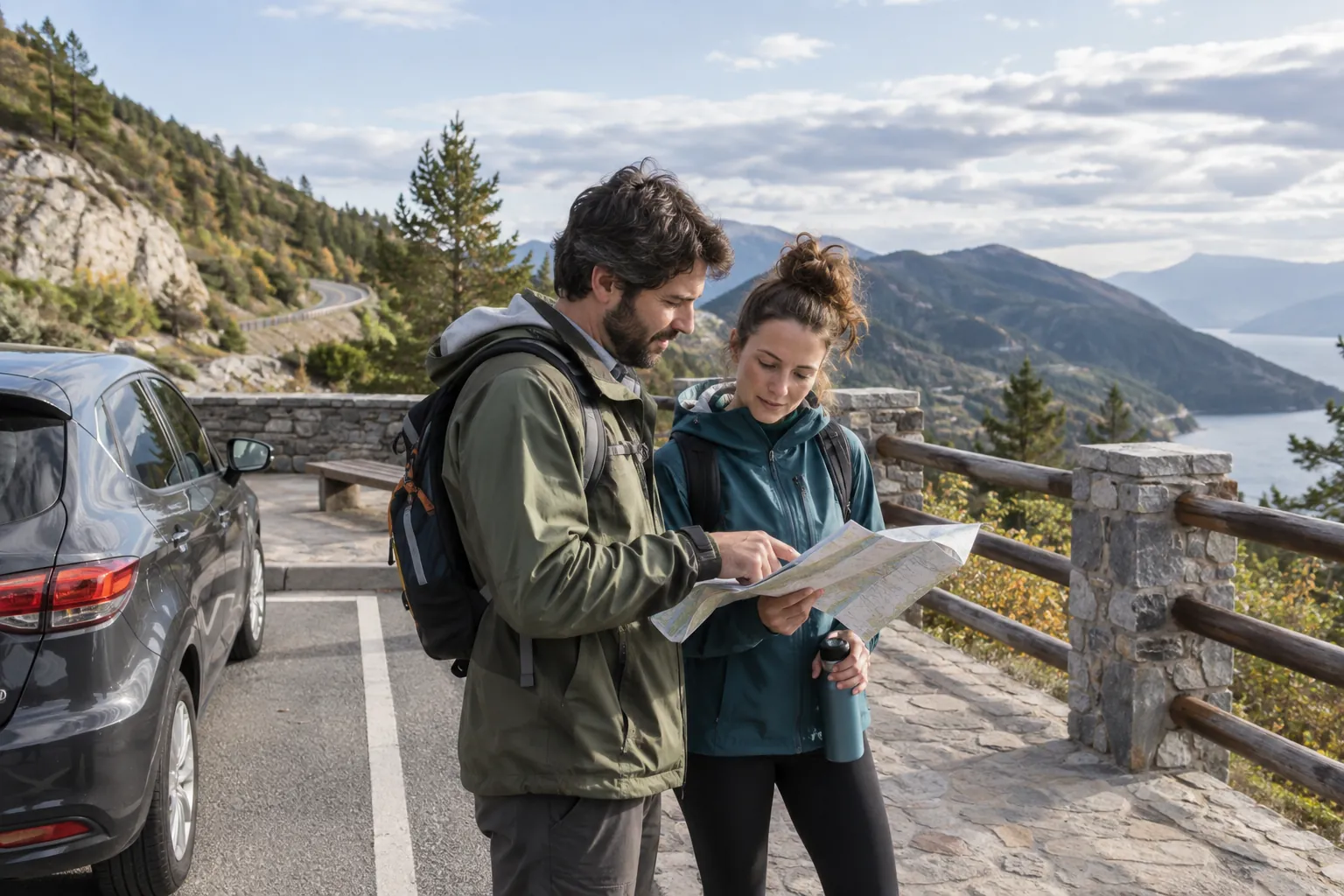
What a curve does to a passenger
Through every bend, the car pushes you toward the outside of the curve, and your body and head lean in response. Then the road straightens or reverses, the push flips sides, and your head swings back across. On a winding road this cycle repeats every few seconds for miles: sway left, sway right, with irregular timing set by whatever the road does next. Unpredictable, repeated side-to-side motion of the head is close to a textbook recipe for motion sickness.
Passengers get the raw version because they cannot see far enough ahead to brace, and back-seat passengers get the rawest of all: less road view, more body roll, and often a screen in hand. Drivers, as always, barely suffer, because every curve is their own decision executed on their own schedule.
Why mountain roads are the final exam
Mountain and coastal switchbacks add layers on top of the sway cycle. Hairpins are tight enough that the car slows into them and accelerates out, mixing surge into the side-to-side rhythm. Descents put steady braking under everything, tilting you gently forward for minutes at a time, and crests and dips add moments of floating and settling. The scenery, ironically, makes people look sideways or down at cameras instead of at the road, cutting the one visual feed that helps.
Heat and winding roads also travel together: summer passes, closed windows on dusty gravel, engines working hard. A warm cabin lowers everyone's threshold. This stack is why a family that handles the interstate fine can come apart in the last forty minutes to a mountain lake.
Beating the curves when you cannot avoid them
The driver holds the biggest lever: smooth, slow cornering. Taking bends at a pace that halves the sideways push does more for the back seat than any remedy, and pausing at a viewpoint every twenty minutes gives everyone a reset with a bonus view. Timing helps too, since cool morning air beats a hot afternoon cabin.
Passengers should claim the front seat if they are the sensitive one, keep eyes far up the road through the windscreen so each curve is seen before it is felt, and lean gently with the car rather than fighting the push. Skip reading and screens entirely on the winding section; they can wait for the highway. And if a route choice genuinely exists, remember that scenic is a cost paid in curves: sometimes the answer is to drive the fast road and hike to the view instead.
When to use which
Choose the highway routing when a sensitive passenger is aboard and the destination is the point; the extra minutes are cheap against an hour of misery and a ruined evening. Take the winding road when it is the point, and stack the deck: morning start, cool cabin, sensitive rider up front with eyes on the road, driver briefed to corner gently, stops planned at viewpoints. Treat descents with respect, since braking adds a second axis of motion to the sway. And decide before the first hairpin, not after the first wave of nausea, which is exactly when good decisions stop being available.
Try drug-free motion sickness relief
Get your personalized Dizzout plan · iOS and Android · any headphones.
Frequently asked questions
Why do winding roads make me carsick when highways don't?
Curves swing your body and head side to side, and a winding road reverses that swing every few seconds with timing your brain cannot predict. Highways barely move you sideways at all. Add the braking and accelerating around tight bends and the hidden sight lines of hilly terrain, and a curvy road delivers dozens of provocations per minute where a highway delivers a handful per hour. It is the most reliable everyday trigger for car sickness.
Is going downhill worse than uphill for car sickness?
Many passengers find descents worse, and the mechanics agree: going down adds sustained braking to every curve, so you get tilted gently forward while also swinging side to side, and drivers tend to carry more speed into downhill bends than uphill ones. If your route has a big climb and descent, expect the way down to be the harder half and plan the front seat, the slower cornering and the rest stop accordingly.
Does the driver's style really matter that much on curves?
It is the single biggest variable. The sideways push in a corner grows steeply with speed, so a driver who takes the same bends noticeably slower and brakes before the curve rather than in it can cut the motion the passengers feel dramatically. Drivers themselves feel fine, which is why they underestimate it; the fix is a direct request before the winding section starts. Meanwhile the passenger's own job is eyes far ahead through the windscreen.
Curves are the price of scenery, and it is a real price for some stomachs. Pay it deliberately: slow driver, front seat, cool air, morning light, and eyes on the road that is about to happen. Or take the straight road and spend the savings standing at the view instead of swaying toward it.
Related comparisons
- How famous road trip routes rate for motion sickness
- City traffic vs highway
- Road trip nausea: long-drive strategies
- How to prevent car sickness on long drives
- All motion sickness comparisons
This page is general information, not medical advice; individual reactions to motion vary widely. Drive to the conditions first: no passenger-comfort tactic outranks safe speeds and attention on mountain roads.