
City traffic vs highway: which makes you more carsick?
City stop-and-go is the worse ride, and it is not close. Congested streets serve your inner ear an endless cycle of surge and brake with no rhythm to adapt to, stacked with junctions, turns, and a cabin that heats up while you crawl. A highway at cruising speed is the calmest common road environment there is: one direction, one speed, minutes at a time. If a route choice exists, the longer way around on the highway is very often the friendlier trip for a queasy passenger, even when the map calls it slower.
Ask people where their car sickness actually starts and a pattern appears fast: not on the open road, but in traffic. The crawl to the airport, the urban school run, the last congested miles into town after a smooth two-hour cruise. Stop-and-go driving concentrates almost everything that provokes motion sickness into a small, repetitive loop.
The highway, by contrast, is where car travel gets as close as it ever does to rail travel. This page explains the mechanics of the difference, which city conditions are the worst offenders, and how to route and ride so the last mile does not undo the first hundred.
Whichever option you pick, Dizzout is a drug-free backup for the moment nausea starts: precisely calibrated sound on any headphones, free to download on iOS and Android.
Get your personalized Dizzout plan. Paid subscription for full access.

On your phone? Scan to start there.
City stop-and-go vs highway cruising for a queasy passenger
| Factor | City traffic | Highway |
|---|---|---|
| Speed changes | Constant surge-brake cycles | Rare, gradual |
| Direction changes | Junctions, roundabouts, lane weaving | Long straights, gentle curves |
| Rhythm to adapt to | None, spacing is unpredictable | Steady state for minutes at a time |
| Cabin air | Warm, still, exhaust-adjacent | Easy airflow at speed |
| Phone or reading risk | High | Moderate for the sensitive |
| Escape options | Boxed in until a side street | Service stops at intervals |
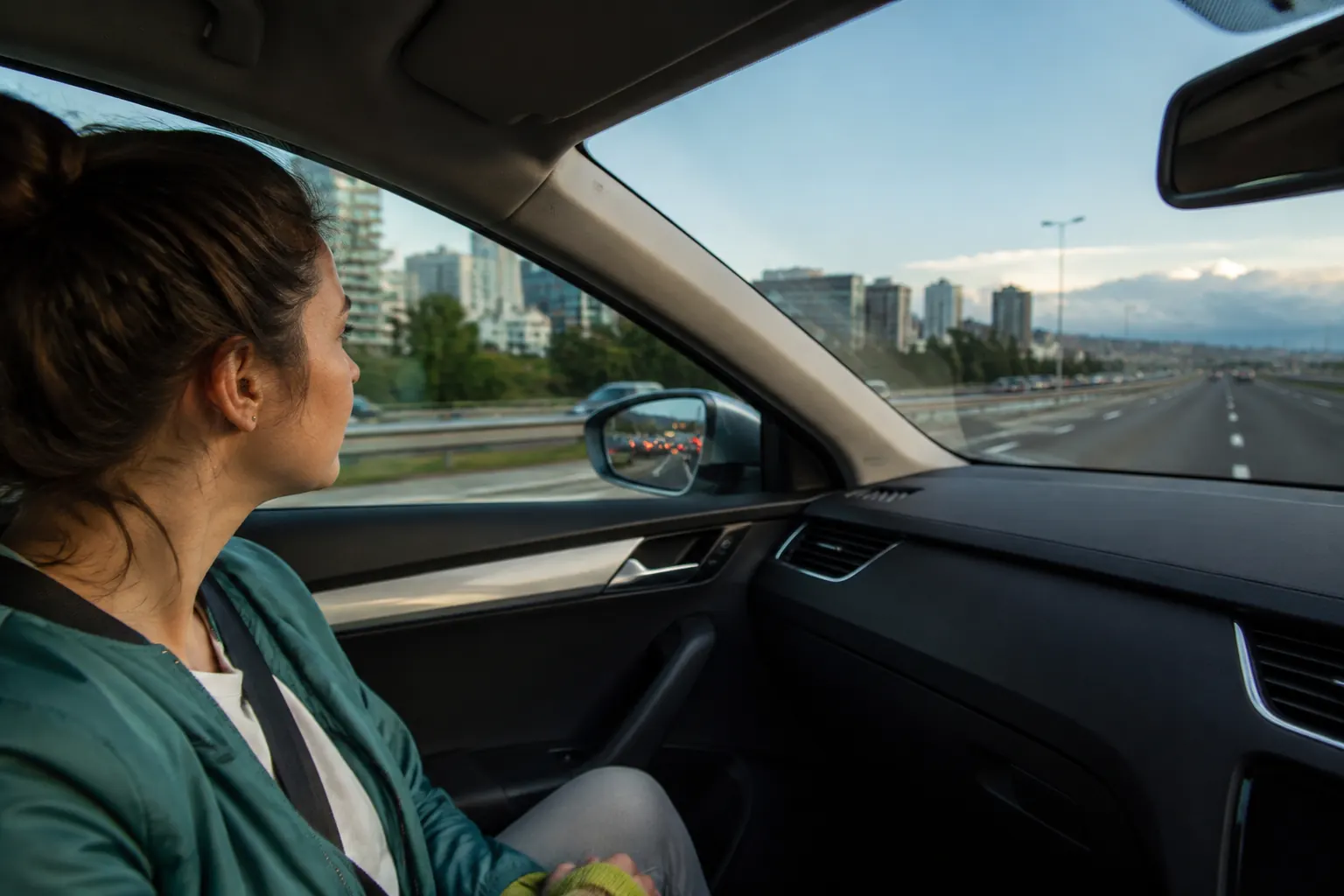
Why the surge-brake cycle is so effective at making you sick
Every cycle of stop-and-go traffic moves you the same way: the car accelerates and presses you back, then brakes and folds you gently forward, then does it again. Each individual event is small, but they repeat dozens of times in a slow mile, and they are irregular: your body cannot find a rhythm to settle into because the spacing depends on the car ahead. Repeated, unpredictable acceleration is precisely the input motion sickness responds to.
A passenger looking at a phone gets the worst version. Between surges there is no visual motion at all in the cabin, so the eyes keep reporting stillness while the body files a fresh motion report every few seconds. Drivers themselves suffer far less here, as everywhere, because their brain issues each brake command before feeling it.
What the city adds on top
Congestion rarely travels alone. City routes add sharp turns at junctions, speed bumps, roundabouts and lane changes, each a lateral or vertical nudge on top of the surge cycle. The cabin environment degrades too: slow traffic means less airflow, more heat, and sitting in the exhaust wash of surrounding vehicles, and warm stale air reliably makes queasy passengers worse. Ride-hail journeys concentrate the problem further, since urban drivers on the clock brake and accelerate harder than family drivers.
None of these factors is dramatic alone. Stacked, they explain why a fifteen-minute crosstown trip can defeat someone who handles two hours of open road without a symptom.
Why the highway is the calm option, and how to use that
At a steady cruise the car is barely doing anything your inner ear can object to: speed constant, direction constant, corrections gentle. Lane changes and the occasional brake are single events, not cycles. This is why long motorway legs are where queasy passengers recover, read a few messages safely, or fall asleep.
You can plan around this. When two routes exist, the one that trades ten minutes of downtown for ten extra highway minutes is usually the better deal for a sensitive passenger. Time departures outside rush hour when you can. And treat the transition honestly: if the trip must end with a congested crawl, get ventilation going and phones down before the traffic starts, not after the first wave of queasiness arrives.
When to use which
Route around congestion when a queasy passenger is aboard: extra highway minutes are cheaper than crosstown ones, and off-peak departures beat rush hour by more than the clock suggests. In unavoidable traffic, set the cabin up before it starts: cool air moving, phones away, eyes up and far down the road, and conversation going, since a talking passenger is usually looking up. If symptoms begin anyway, a ten-minute stop with fresh air resets most people better than pushing through the last two miles, and city driving is exactly where stopping is possible.
Try drug-free motion sickness relief
Get your personalized Dizzout plan · iOS and Android · any headphones.
Frequently asked questions
Why does rush hour traffic make me feel sick when highway driving doesn't?
Stop-and-go traffic delivers repeated, irregular cycles of acceleration and braking, and repetition without rhythm is the exact input motion sickness responds to. The highway at cruise is the opposite: constant speed, constant direction, almost nothing for your inner ear to report. Add the city extras, turns, bumps, warm still air and a phone in your lap, and a slow mile can outdo a fast hundred.
Does being the driver help in stop-and-go traffic?
Yes, dramatically. The driver's brain issues every brake and throttle command a moment before feeling the result, so nothing arrives as a surprise, and drivers rarely get sick in the same traffic that flattens their passengers. If two adults are in the car and one is prone, putting the prone one behind the wheel for the congested stretch is a legitimate tactic. Our page on why drivers don't get car sick explains the effect properly.
Why is a taxi or rideshare in the city the worst version of this?
You get the full stop-and-go cycle plus an unfamiliar driver working to a clock, which usually means harder braking and sharper gaps than a family driver, and you are often in the back seat looking at a phone to boot. That combination, rear seat, no road view, urgent driving, screen down, stacks most of the known aggravators at once. Our rideshare guide covers what to change, starting with where you look.
Traffic is a nausea machine with a simple design: surge, brake, repeat. Starve it where you can, with routing, timing and a driver's-eye view of the road, and give the highway the miles. Your stomach knows the difference between slow and steady, even when the map does not.
Related comparisons
- Why rideshares make you carsick
- Winding roads vs highway
- Motion sickness while commuting
- Why drivers don't get car sick
- All motion sickness comparisons
This page is general information, not medical advice; individual reactions to motion vary widely. If car sickness is frequent or severe enough to affect daily life, talk to a doctor or pharmacist about the right approach for you.