Car vs train: which is worse for motion sickness?
The car is worse for almost everyone who gets motion sick, and the gap explains a familiar mystery: the same person who cannot read a single page in a moving car can work on a laptop for two hours on a train. A car changes speed and direction constantly, in ways a passenger cannot predict. A train holds a steady speed through long, banked curves, which your inner ear barely registers. If a journey offers both and you are prone, the train is the motion-friendly choice, and it is the only land transport where reading stays realistic for most sensitive people.
Car versus train is really a comparison between two kinds of motion. Road motion is busy: accelerate, brake, weave, corner, repeat, with every input decided by traffic and a driver who is not you. Rail motion is sparse: long stretches of constant speed, gentle engineered curves, and braking events you can count on one hand per hour. Motion sickness feeds on change and surprise, so the sparse option wins by a distance.
This page covers why the difference is so large, the exceptions where trains still bite, and the question behind half the searches on this topic: why reading works on one and not the other.
Whichever option you pick, Dizzout is a drug-free backup for the moment nausea starts: precisely calibrated sound on any headphones, free to try on iOS and Android.
Free to try, no card needed. Or go straight to the App Store or Google Play.
Car vs train, motion factor by motion factor
| Factor | Car | Train |
|---|---|---|
| Speed changes | Constant, traffic-driven | Rare and gradual |
| Direction changes | Every bend, lane change and correction | Long banked curves only |
| Predictability for a passenger | Low in the back, better up front | High everywhere |
| Reading and screens | Risky for the prone | Realistic for most people |
| Freedom to move | Belted in place | Stand, walk, change seats |
| Reset options | Pull over anytime | Wait for the next stop |
| Verdict for the prone | Manageable up front, hard in the back | Default choice |
What your inner ear gets from each ride
Your vestibular system responds to changes: speeding up, slowing down, tilting, turning. A car on an ordinary journey produces those changes continuously. Even a smooth driver on a quiet road is constantly making small corrections, and traffic adds surges and stops on top. Sit in the back where the road ahead is half-hidden and each of those inputs arrives unannounced.
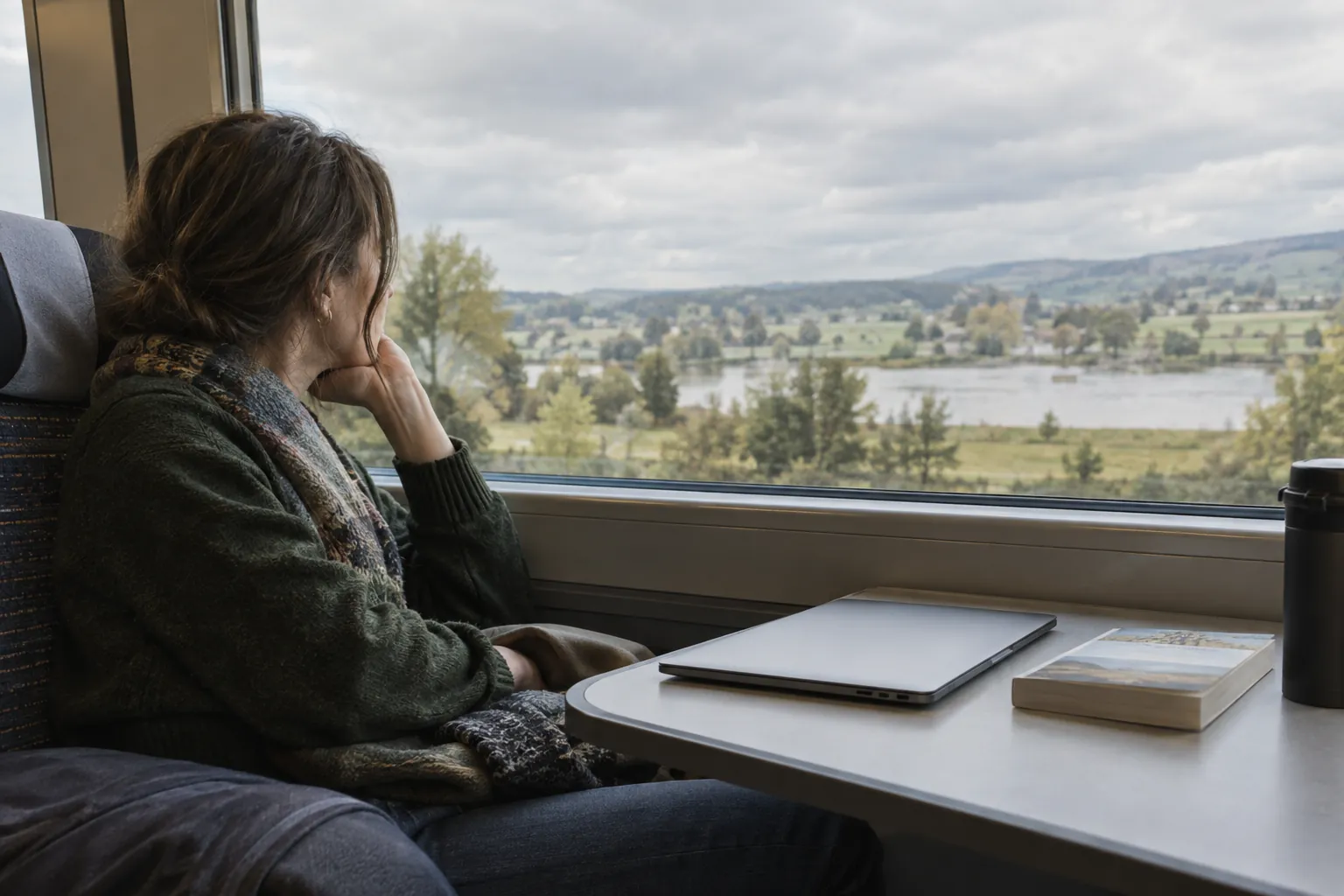
A train produces remarkably few changes. It cannot weave inside its lane, it corners on curves designed to be taken at speed with the track banked into the turn, and its acceleration is spread over a minute rather than a second. Between stations, cruising rail motion is close to what your inner ear calls nothing. That is the whole story in one line: cars generate provocations by the dozen per minute, trains by the handful per hour.
Why you can read on a train but not in a car
Reading intensifies whatever conflict already exists. Eyes locked on a page report a stationary world while the body feels motion; the bigger and more frequent the felt motion, the bigger the disagreement. In a car the disagreement is renewed at every brake and bend, so a chapter that starts fine ends with cold sweat. On a train the felt motion is small and steady, so the disagreement barely accumulates, and most people can read or work for hours.
Sensitive readers can still be caught by rough older lines, curvy sections and backwards-facing seats. If that is you, glance out the window between paragraphs, face forward, and save the reading for the smooth stretches. Our page on reading in the car covers the road version of this problem in depth.
The practical trade-offs beyond your stomach
Cars win on flexibility: door to door, your own schedule, easy stops. Those stops matter, because pulling over for ten minutes of fresh air is a genuine reset button that a train cannot offer. The car front seat is also a legitimately decent place for a motion-sensitive passenger, with a full windscreen of road to anchor the eyes, and health guidance such as the CDC's recommends the front for exactly that reason.
But for a passenger in the back on a long or winding route, the car is the harder environment on land transport short of a coach on the same road. Where a railway parallels your journey, the train converts travel time into usable time: reading, working, walking to the buffet car, none of which survive a back seat. For commuters that difference compounds every single day.
When to use which
Take the train when the route offers one and motion sickness is a real factor for you, and especially when you plan to read or work in transit. Take the car when door-to-door flexibility matters more, and set it up honestly: the sensitive passenger rides up front with eyes on the road, the windows crack open on hills, and the schedule includes stops rather than pretending it will not need them. Mixed itineraries are underrated, too: many journeys can swap their longest, straightest leg to rail and keep the car for the ends.
Try drug-free motion sickness relief
Try Dizzout Free
Free to try on iOS and Android · ~90 seconds · works on any headphones.
Frequently asked questions
Why do I get carsick but never train sick?
Because the two vehicles feed your inner ear completely different diets. A car delivers constant small accelerations, brakes and turns, most of them unannounced if you are not watching the road. A train delivers long steady cruising with rare, gradual changes on banked curves. Motion sickness is triggered by repeated unexpected motion, so the car provides the trigger and the train mostly does not. It is one of the most commonly reported patterns in motion sickness.
Can you get motion sick on a train?
Some people can, usually while reading through curvy or rough sections, riding backwards, or standing in a moving carriage. It is far less common than car sickness and usually settles quickly if you look out the window, face the direction of travel or sit down. Where you sit makes a difference too, and our train seating guide covers that side of it.
Is driving the car myself better than taking the train?
For motion sickness specifically, driving is famously protective: the driver's brain predicts every input because it creates them, which is why drivers rarely get sick on roads that flatten their passengers. If you are the driver, the car and the train are both fine choices and the decision can rest on other factors. If you will be a passenger, the train is the gentler ride. Our page on why drivers don't get car sick explains the effect.
Cars make motion; trains mostly avoid making it. Ride up front and watch the road when the car is the answer, and let the rails carry you when they are on offer, book in hand, stomach unbothered.
Related comparisons
- Train seating guide
- Why reading in a car makes you sick
- Bus vs train for motion sickness
- Why drivers don't get car sick
- All motion sickness comparisons
This page is general information about how vehicle motion tends to affect people; individual reactions vary widely and this is not medical advice. If travel sickness is frequent or severe, talk to a doctor or pharmacist about the right approach for you.