
Does the Pendolino (Class 390) make you motion sick?
The Pendolino is the train that made tilt sickness a British conversation. Its active tilt leans each carriage up to 8 degrees into curves, which lets it run the winding West Coast Main Line fast, and most riders feel nothing worse than a lean. A minority feel genuinely queasy on it, reliably, and the tilting-train research explains why: the carriage cancels the sideways push but your inner ear still feels the roll, while the interior around you stays visually level.
West Coast Main Line, UK · Active tilt, up to 8 degrees
Key facts
- Each Class 390 carriage tilts up to 8 degrees from vertical.
- The Class 390 is an electric high-speed tilting train built by Alstom between 2001 and 2005, with tilt technology from the Fiat Ferroviaria line, and is operated by Avanti West Coast.
- Published research on tilting trains reports more motion sickness on tilting than on comparable non-tilting services, linked to carriage roll and tilt timing.
Queasy on the train? Dizzout is drug-free sound therapy you can start from your seat, with relief in about 90 seconds.Starts in your browser · works with any headphones
Get your personalized Dizzout plan. Paid subscription for full access.

On your phone? Scan to start there.
Why the Pendolino (Class 390) feels the way it does
Tilt: Active
Electro-hydraulic active tilt from the Fiat Ferroviaria lineage, built by Alstom. Each carriage tilts up to 8 degrees so the train can hold speed through the West Coast Main Line's curves.
On a non-tilting train, a fast curve pushes you sideways in your seat and your body reads one consistent story. The Pendolino removes most of that push by rolling the carriage into the curve, so what remains is roll your inner ear feels but your eyes cannot see, because the tables, luggage racks and floor tilt with you. Peer-reviewed work on tilting trains reports more motion sickness on tilting services than on non-tilting ones over the same lines, and points at the roll motion and the timing of the tilt relative to each curve as the drivers. The busiest complaint stretches in rider threads are the curving legs north of Preston and through the Lake District fringe, which is where the tilt works hardest.
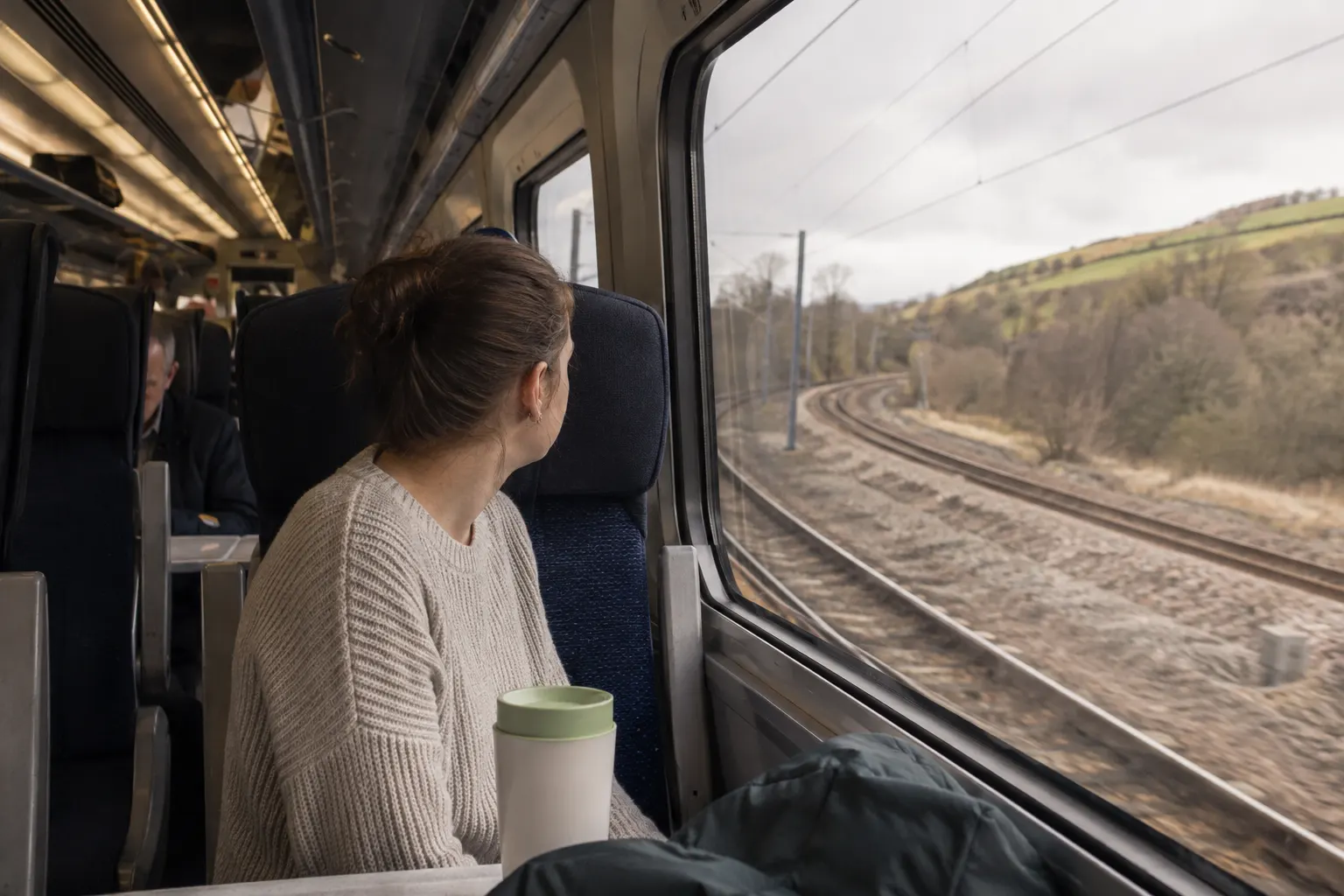
Where it runs
- Avanti West CoastLondon Euston to Birmingham, Manchester, Liverpool and Glasgow
What the research says about tilting trains
Tilting-train motion sickness has a real, peer-reviewed literature: studies report more sickness on tilting than on comparable non-tilting trains, and point at carriage roll, the level of tilt compensation and the timing of each tilt against the curve as the variables that matter.
- Persson R, Tilting trains: benefits and motion sickness, Proc IMechE Part F, 2010
- Determinants of motion sickness in tilting trains, Frontiers in Neurology, 2017
- Forstberg J, Ride comfort and motion sickness in tilting trains, doctoral thesis, 2000
Pack the screen before boarding
Get your phone and headphones ready before the journey if you plan to use Dizzout. Keep the laptop packed so you can leave the screen alone on winding sections.
Free to download. Paid subscription for full access.
30,000+ travelers in 30+ countries · How we count

On your phone? Scan to start there.
Comparing apps first? See how the motion sickness apps compare

Know someone who gets motion sick?
Send them the app that helps stop it, drug-free, in about 90 seconds, works with any headphones. Free to download.
What helps on board
- Watch the outside world through the fast Cumbrian sections. The tilt is designed to be invisible inside the carriage, and the passing landscape is what tells your inner ear why you feel roll.
- Phones and laptops are fine on the flatter southern stretches; put them away when the route starts winding through the hills.
- Cool the air around you: the vents help, and a minute in the vestibule with cooler air resets a building wave.
- Board with relief ready. If nausea starts mid-journey, sound therapy through any headphones is a drug-free option with relief in about 90 seconds.
Where to sit is its own question, answered properly in where to sit on a train for motion sickness. And for why trains set people off at all, from sway to reading to tilting stock, see the train motion sickness guide.
Frequently asked questions
Why does the Pendolino make some people feel sick?
The active tilt rolls the carriage into curves to cancel the sideways force. Your inner ear still senses that roll, but the carriage interior stays visually level around you, so the two inputs disagree. Research on tilting trains identifies the roll motion and the tilt's timing against each curve as the main drivers of nausea in susceptible riders.
Is the Pendolino worse than a normal train for motion sickness?
For most riders, no: the tilt makes the fast curves feel smoother, not rougher. For a susceptible minority the answer is yes, and it is documented. Studies comparing tilting and non-tilting trains on the same kind of line report more motion sickness on the tilting services.
Can I avoid the tilt on the West Coast Main Line?
Partly. TransPennine Express runs non-tilting Class 397 and 802 trains over the northern West Coast Main Line between Manchester, Liverpool and Scotland, taking the same curves at lower speed without the roll. On Avanti's London services the Pendolino is the standard train on most fast diagrams.
Which parts of the route feel the most?
The tilt earns its keep on the curving northern half, roughly Preston through the Lake District fringe to the Scottish border. The southern half out of Euston is straighter and faster, and the tilt does much less there.
Other trains and lines
Sources & further reading
Your next question, probably
Feeling it right now, on board?
The 60-second protocol
Not your question? Why do trains set some people off?What actually has evidence?How prone are you, really?
Details on this page reflect published operator, heritage and engineering information as of September 2026; services, fleets and tilt settings change, so check with the operator before you travel. Train, route and operator names are trademarks of their respective owners; Dizzout is not affiliated with or endorsed by them. Motion sickness sensitivity varies from person to person; this page is informational and not medical advice.