
VW ID.4 Motion Sickness: B Mode, D Mode and Regen
The Volkswagen ID.4 gets mixed, very person-dependent motion sickness reports from passengers; the thing sensitive riders notice most is whether the car slows itself on lift-off, which depends on the drive mode. In D, Volkswagen says it coasts in most cases when the driver lifts off, and B is the mode that slows the car on lift-off. One owner who moved from B back to D wrote that D smooths everything out for passengers, so D is the setting to keep when someone gets queasy.
Going on a ride in the Volkswagen ID.4? Dizzout is drug-free sound therapy for passengers in the back seat, with relief in about 90 seconds.Free to download · works with any headphones
Stop car sickness. Free to download on iPhone and Android. Paid subscription for full access.

On your phone? Scan to start there.
Compact SUV · EV · Reader-reported motion-sickness risk: mixed, very person-dependent.
- Low
- Moderate
- High
- Very high
Risk levels summarise what passengers and riders commonly report, not measured testing.
Key facts
- The Volkswagen ID.4 is a compact SUV. It is fully electric.
- Reader reports place it in the moderate band for motion sickness.
- 6 design factors are documented on this page as motion triggers in the Volkswagen ID.4.
- Best seat: Sit up front with your eyes on the road ahead.
- Settings that matter: Stay in D: Volkswagen says the ID.4 coasts in most cases in D when the driver lifts off, while B slows the car on each lift-off.
Why the Volkswagen ID.4 can trigger motion sickness
Volkswagen chose coasting as the ID.4's default behavior. Its 2020 launch material says that in D the car coasts in most cases when the driver lifts off, and recovers energy when the brake pedal is pressed. B, which the current quick start guide says engages energy recuperation when coasting, slows the car on lift-off. Volkswagen put that slowing at up to about 0.13 g and said it stops short of a standstill, so B has no full one-pedal feel. Even so, the back-and-forth can bother passengers. On the Volkswagen ID Forum, one owner wrote that they moved from B to D after passengers and family members said they were getting carsick from the constant speed changes, and that riding as a passenger in B felt nauseating to them too. A 2025 on-road study of 16 motion-sensitive passengers found more motion sickness with high regeneration than with a lower setting.
- D coasts in most cases on lift-off, as Volkswagen describes it, the gentlest behavior for passengers
- B recovers energy on each lift-off, a slowing Volkswagen put at up to about 0.13 g
- B stops short of a standstill, so there is no full one-pedal stop, yet one owner still found it nauseating as a passenger
- Switching often between D and B makes lift-offs feel different from one moment to the next, which passengers cannot predict
- A quiet electric cabin removes the engine note that warns a rider the car is about to slow
- Rear-seat riders get the least forward view, so speed changes arrive without warning
Best seat & setup in the Volkswagen ID.4
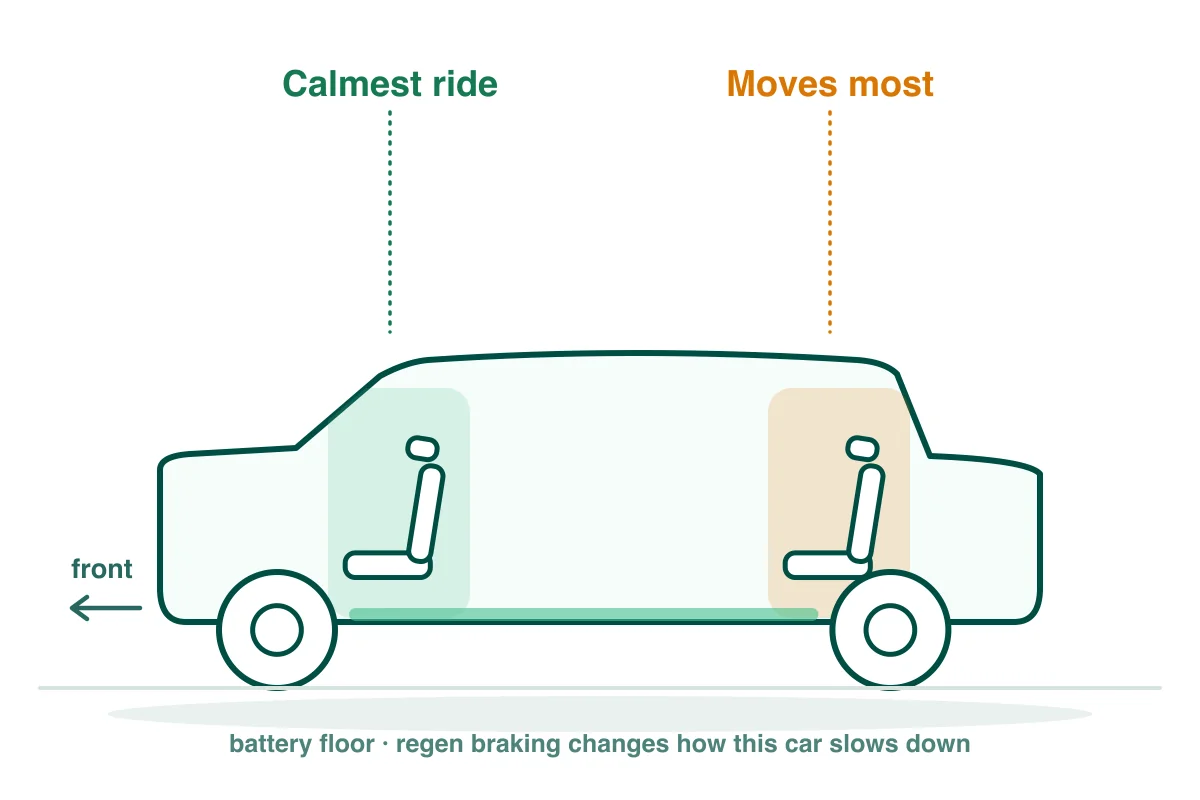
Sit up front with your eyes on the road ahead. Ask the driver to stay in D, brake early and gently, and save B for drives without a sensitive passenger aboard.
Stay in D: Volkswagen says the ID.4 coasts in most cases in D when the driver lifts off, while B slows the car on each lift-off. The current quick start guide says B is selected with the gear selector on the right of the steering column, by twisting it forward twice from N, and that B engages energy recuperation when coasting. In D, the slowing comes mostly from the brake pedal, which the driver can apply gently.
Comparing EVs? See which EVs let you turn regen down or off.
Comparing SUVs? See which SUVs have a documented comfort setting, and where the third row sits.
Going on a ride in the Volkswagen ID.4? Have Dizzout ready
Stop car sickness
Dizzout is drug-free sound therapy for passengers in the back seat, with relief in about 90 seconds. It plays precisely calibrated audio through any headphones you already own, wired or Bluetooth. Free to download.
Free to download on iPhone and Android. Paid subscription for full access.
30,000+ travelers in 30+ countries · How we count

On your phone? Scan to start there.
Comparing apps first? See how the motion sickness apps compare
Not travelling yet? Remind me the day before my trip
Know someone who gets motion sick?
Send them the app that helps stop it, drug-free, in about 90 seconds, works with any headphones. Free to download.
What helps in the Volkswagen ID.4
- Keep the ID.4 in D, which mostly coasts on lift-off, when a sensitive rider is aboard
- Ask the driver to brake early and gently rather than relying on B to slow the car
- Sit up front and keep your eyes on the road ahead and the horizon
- Crack a window or aim a vent at your face for cool, fresh air
- Put phones and books away while the car is moving
- Dizzout is a drug-free, screen-free sound therapy you can start the moment symptoms begin; Dizzout states relief in about 90 seconds. Over-the-counter options also exist, so follow the label or ask a pharmacist.
The screens-away item on that list has a page of its own, with the trials attached: see the verdict on putting your phone away.
Why cars set off nausea at all, and what to do once it starts in any car, is in our car sickness guide.
Comparing apps for the drive? The car sickness app guide sets sound therapy against on-screen motion cues, free options included.
Frequently asked questions
Does the Volkswagen ID.4 cause motion sickness?
Some passengers report it. On the Volkswagen ID Forum, one owner wrote that passengers and family members were getting carsick from the back-and-forth in B, so they switched to D, which they said smooths everything out. Volkswagen designed D to coast in most cases when the driver lifts off.
How do I reduce regenerative braking in the Volkswagen ID.4?
Drive in D rather than B. Volkswagen says the ID.4 coasts in most cases in D when the driver lifts off, while B recovers energy on lift-off, a slowing it put at up to about 0.13 g. The current quick start guide says B is selected by twisting the gear selector on the right of the steering column forward twice from N.
Is B mode or D mode better for a carsick passenger in an ID.4?
D. It coasts in most cases on lift-off, so most of the slowing comes from the brake pedal, which the driver can apply gently. B slows the car on each lift-off, and one owner who drove in B found it nauseating when they rode as a passenger.
Other car motion-sickness guides
Sources & further reading
- https://www.vw.com/en/owners-and-services/about-my-vehicle/quick-start-guides.html/__app/2026/id-4/driving-modes.app
- https://www.volkswagen-newsroom.com/en/press-releases/brake-or-coast-the-id4s-intelligent-energy-recuperation-concept-6658
- https://www.vwidtalk.com/threads/hyper-miling-your-id-4.3676/
- https://insideevs.com/news/766726/electric-vehicle-making-you-carsick/
- https://doi.org/10.1080/10447318.2025.2499155
Based on publicly reported owner experiences and the vehicle's documented design characteristics, as of 2026. Vehicle and brand names are trademarks of their respective owners; Dizzout is not affiliated with or endorsed by them. Motion-sickness sensitivity varies by person, so this is informational, not a vehicle review or a substitute for a doctor's advice.