
Motion Sickness in the BMW i3: Why It Happens & How to Prevent It
The BMW i3 was one of the first cars to popularize true one-pedal driving, and that strong lift-off regen is exactly what some owners report as a motion-sickness trigger, especially in stop-and-go traffic. It is a useful "early EV" case: the regen feel that gets discussed around Teslas today was already a talking point on the i3 years earlier.
Hatchback · EV · Reader-reported motion-sickness risk: mixed, very person-dependent.
- Low
- Moderate
- High
- Very high
Risk levels summarise what passengers and riders commonly report, not measured testing.
Key facts
- The BMW i3 is a hatchback. It is fully electric.
- Reader reports place it in the moderate band for motion sickness.
- 6 design factors are documented on this page as motion triggers in the BMW i3.
- Best seat: Sit up front with eyes on the road and the horizon, where the i3's tall, glassy cabin gives a clear forward view.
- Settings that matter: The i3's one-pedal regen isn't user-selectable like some newer EVs, so the main lever is technique: find the accelerator's coasting "sweet spot" and ease off gradually instead of lifting off all at once, which softens the lift-off deceleration that owners report as the trigger.
Try Dizzout free. Put it on your phone before you go, so it is there when you need it. Drug-free, any headphones.Free · works with any headphones · no account to try
Stop car sickness. Free to try, no card needed. Or go straight to the App Store or Google Play.
Why the BMW i3 can trigger motion sickness
When you lift off the accelerator in an i3, regenerative braking produces a firm, sustained deceleration with a noticeable jolt at the moment of lift-off, and owners on the BMW i3 forum commonly describe this as a trigger, particularly in stop-and-go traffic where they are repeatedly on and off the pedal. The i3's regen was set unusually strong at launch; BMW is reported to have later softened the maximum regen partly in response to smoothness complaints, with a software update said to delay the onset of full regen after a sudden pedal release. To its credit, the i3 has a tight, planted city-car feel and a panoramic, upright greenhouse that gives a clear view of the road ahead, and owners consistently report that smoothing your own pedal inputs largely tames the sensation.
- Strong, early one-pedal regen: lifting off the accelerator produces firm deceleration with a distinct jolt that passengers can't anticipate
- Most provocative in stop-and-go traffic, where drivers are constantly on and off the pedal (owners liken the on-off pitch to an aircraft descent)
- Reported to have had its maximum regen partly reduced over smoothness complaints, via a software update that delayed the onset of full regen
- Quiet EV cabin removes the engine-pitch and rev cues a gas car gives the brain to predict braking
- Tall, narrow, short-wheelbase city-car body can amplify the felt fore-aft pitch
- On the plus side: upright seating and large glass give good outward visibility, and owners report the feel smooths out once you adapt your pedal technique
Best seat & setup in the BMW i3
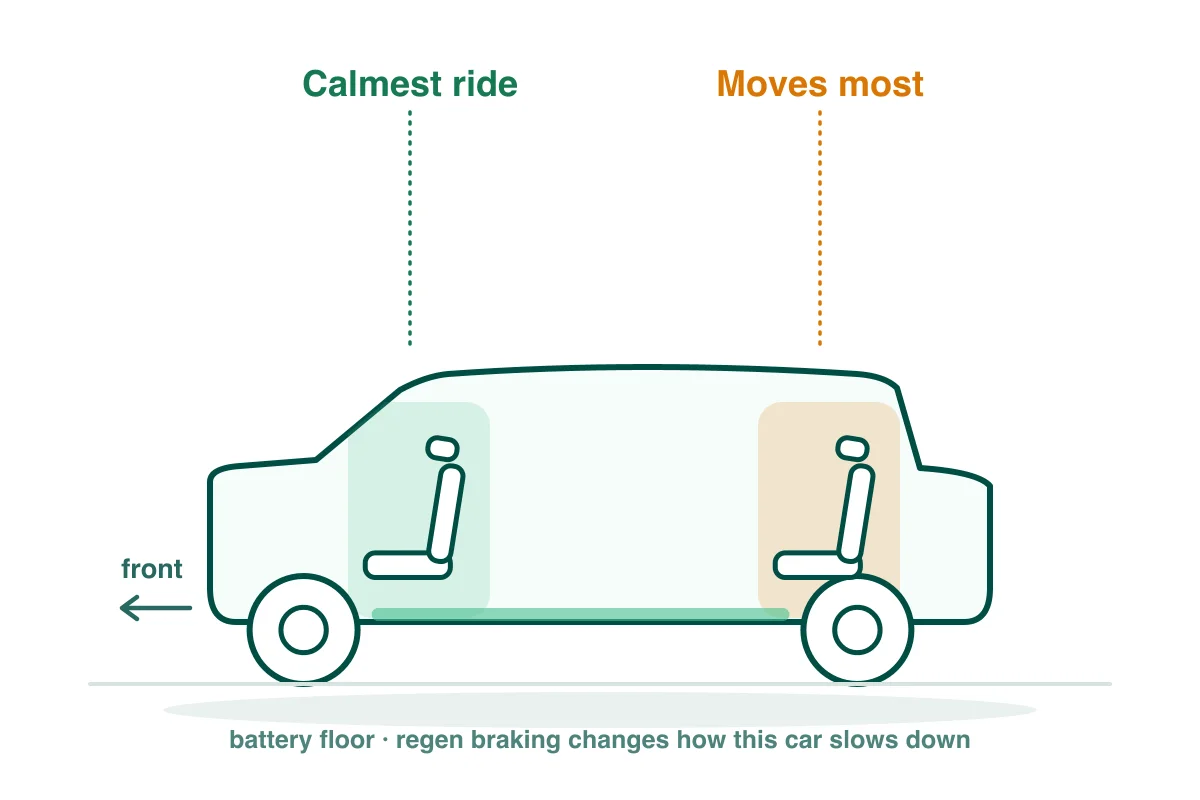
Sit up front with eyes on the road and the horizon, where the i3's tall, glassy cabin gives a clear forward view. The driver can soften the experience for everyone by feathering the accelerator to coast into stops rather than lifting off abruptly, and by taking surface streets gently in stop-and-go conditions.
The i3's one-pedal regen isn't user-selectable like some newer EVs, so the main lever is technique: find the accelerator's coasting "sweet spot" and ease off gradually instead of lifting off all at once, which softens the lift-off deceleration that owners report as the trigger. If your i3 has Eco Pro or Eco Pro+ alongside Comfort, switching to Eco Pro softens the accelerator response so acceleration comes on more gently for sensitive passengers, though it won't change the lift-off regen deceleration itself.
Going on a drive in the BMW i3? Set it up first
Set it up before you pull out, not at the first lay-by. Dizzout is a drug-free app that plays precisely calibrated audio through any headphones you already own, wired or Bluetooth, with relief in about 90 seconds. Free to try.
Before you need it: find out how prone you are
Take the free 2-minute testTwo minutes, no sign-up, and it ends with a drug-free plan to prepare.
Put it on your phone before you go
Free to try, no card needed. Or go straight to the App Store or Google Play.
 Scan to open on your phone
On a computer? Dizzout installs on your phone. Scan the code, or open dizzout.com/get on your phone and it'll take you straight to the right store.
Know someone who gets motion sick?
Send them the app that helps stop it, drug-free, in about 90 seconds, works with any headphones. Free to try.
What helps in the BMW i3
- Have the driver feather the accelerator to coast smoothly into stops instead of lifting off sharply, which is the fix i3 owners most often credit
- Sit in front and keep your eyes on the road ahead and the horizon, using the i3's large windows
- Crack a window or aim a vent at your face for cool, fresh air
- Put phones, books, and screens away while moving, since looking down widens the sensory mismatch
- Keep stop-and-go drives short and choose smoother through-routes where you can
- Dizzout is a drug-free, screen-free sound therapy you can start the moment symptoms begin; most users feel better in about 90 seconds. Over-the-counter options also exist for some people, so follow the label or ask a pharmacist.
The screens-away item on that list has a page of its own, with the trials attached: see the verdict on putting your phone away.
Frequently asked questions
Why does my BMW i3 make me carsick in traffic but not on the open road?
Stop-and-go traffic is the condition i3 owners report as the worst, because you're constantly lifting off and pressing the accelerator, and each lift-off triggers the car's firm regen deceleration. On the open road you settle into a steady speed with fewer of those abrupt on-off transitions, so the unpredictable pitching that drives the queasy feeling happens far less.
Did BMW reduce the i3's regenerative braking because of motion sickness?
BMW is reported to have softened the i3's maximum regen partly in response to complaints that it was hard to drive smoothly, and owners describe a software update that delayed the onset of full regen after a sudden pedal release. It's best understood as a reported smoothness refinement rather than a stated motion-sickness recall, and reactions were mixed, since some drivers preferred the original stronger setting.
Can I turn off one-pedal driving in the BMW i3?
The i3's strong regen is part of its one-pedal design and isn't switched off the way some newer EVs let you, so the practical approach is technique: ease off the accelerator gradually to coast into stops rather than lifting off abruptly. Sitting up front with eyes on the horizon and keeping fresh air moving also helps motion-sensitive passengers.
Other car motion-sickness guides
Sources & further reading
Your next question, probably
Car sick on every single drive?
The graded plan that builds tolerance ride by ride
If that is not your question:
Based on publicly reported owner experiences and the vehicle's documented design characteristics, as of 2026. Vehicle and brand names are trademarks of their respective owners; Dizzout is not affiliated with or endorsed by them. Motion-sickness sensitivity varies by person, so this is informational, not a vehicle review or a substitute for a doctor's advice.