
Motion Sickness in the Hyundai Ioniq 5: Why It Happens & How to Prevent It
If the Hyundai Ioniq 5 leaves a passenger feeling slightly queasy, it is usually less about the car than about which regen setting it is in. Among electric crossovers, the Ioniq 5 is one of the easier ones to tune for a motion-sensitive rider, because Hyundai lets you dial deceleration up or down right from the steering wheel.
Crossover · EV · Reader-reported motion-sickness risk: mixed, very person-dependent.
- Low
- Moderate
- High
- Very high
Risk levels summarise what passengers and riders commonly report, not measured testing.
Key facts
- The Hyundai Ioniq 5 is a crossover. It is fully electric.
- Reader reports place it in the moderate band for motion sickness.
- 6 design factors are documented on this page as motion triggers in the Hyundai Ioniq 5.
- Best seat: For a motion-sensitive passenger, have the driver use the right steering-wheel paddle to step regen down toward the lightest level so the car coasts to a softer stop rather than pulling back hard on lift-off.
- Settings that matter: Pull the right steering-wheel paddle to reduce regen one level at a time, or hold it to reach the near-coast Level 0; this softens the lift-off deceleration that a sensitive passenger feels most.
Try Dizzout free. Put it on your phone before you go, so it is there when you need it. Drug-free, any headphones.Free · works with any headphones · no account to try
Stop car sickness. Free to try, no card needed. Or go straight to the App Store or Google Play.
Why the Hyundai Ioniq 5 can trigger motion sickness
Owners discuss the Ioniq 5 more often on the mitigation side of the EV motion-sickness conversation than the trigger side. Its i-Pedal one-pedal mode produces the strong "lift-off" deceleration that some sensitive passengers report, but the car also exposes steering-wheel paddles that step regen down through several levels to a near-coast setting, so the most provocative deceleration can be tuned out without changing cars. Reviewers consistently praise the Ioniq 5 for a composed, planted ride built on a long wheelbase and a low, centrally mounted battery, which keeps body roll minimal and helps it glide over rough roads. The takeaway owners and writers land on is that an EV's regen intensity, not the brand, is the lever that matters here.
- i-Pedal one-pedal mode produces a sustained lift-off deceleration that some sensitive passengers report as the main trigger
- Steering-wheel paddles step regen down through several levels (left paddle adds, right paddle reduces) all the way to a near-coast Level 0
- Quiet EV cabin removes the engine-pitch and vibration cues that help passengers anticipate slowing down
- Instant electric torque can make acceleration feel abrupt if the driver does not feather the pedal
- Composed, planted ride with minimal body roll, frequently praised by reviewers, is a genuine plus
- On the Ioniq 5 N, the synthetic engine sounds of the N e-Shift / Active Sound system incidentally restore some of the missing auditory cues
Best seat & setup in the Hyundai Ioniq 5
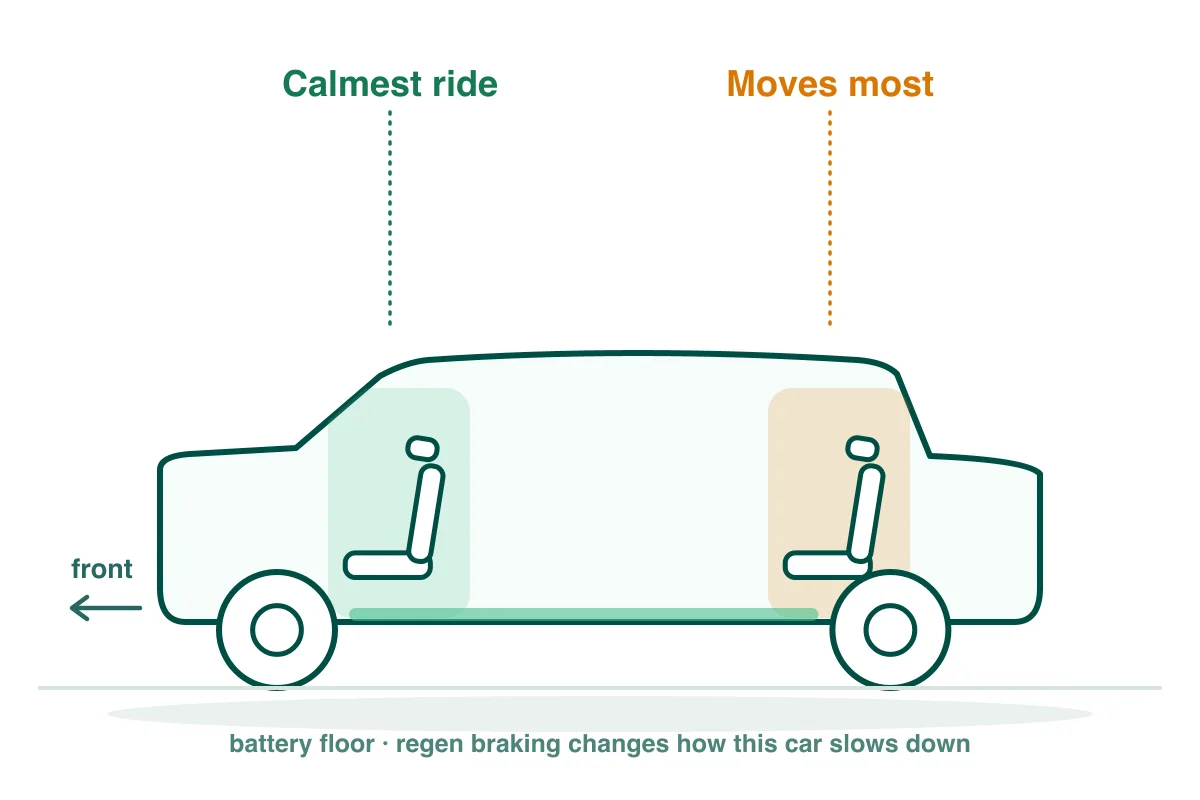
For a motion-sensitive passenger, have the driver use the right steering-wheel paddle to step regen down toward the lightest level so the car coasts to a softer stop rather than pulling back hard on lift-off. Sit up front when possible, with eyes on the road and the horizon rather than on the center screen.
Pull the right steering-wheel paddle to reduce regen one level at a time, or hold it to reach the near-coast Level 0; this softens the lift-off deceleration that a sensitive passenger feels most. Switch out of i-Pedal one-pedal mode and use the brake pedal for smoother, more anticipated stops, and feather the accelerator gently so instant torque does not arrive as a jolt. Note that i-Pedal does not stay selected after parking, so it may need to be reset each drive.
Going on a drive in the Hyundai Ioniq 5? Set it up first
Set it up before you pull out, not at the first lay-by. Dizzout is a drug-free app that plays precisely calibrated audio through any headphones you already own, wired or Bluetooth, with relief in about 90 seconds. Free to try.
Before you need it: find out how prone you are
Take the free 2-minute testTwo minutes, no sign-up, and it ends with a drug-free plan to prepare.
Put it on your phone before you go
Free to try, no card needed. Or go straight to the App Store or Google Play.
 Scan to open on your phone
On a computer? Dizzout installs on your phone. Scan the code, or open dizzout.com/get on your phone and it'll take you straight to the right store.
Know someone who gets motion sick?
Send them the app that helps stop it, drug-free, in about 90 seconds, works with any headphones. Free to try.
What helps in the Hyundai Ioniq 5
- Step regen down with the right paddle (toward the lightest/near-coast level) and switch out of i-Pedal so deceleration feels gradual and predictable
- Sit in the front seat with eyes on the road ahead and the horizon, not on the center touchscreen
- Crack a window or aim a vent toward your face for cool, fresh airflow
- Avoid reading, texting, or watching screens while the car is moving
- Ask the driver to feather the accelerator and brake gradually so torque and slowing arrive smoothly
- Dizzout is a drug-free, screen-free sound therapy you can start the moment symptoms begin; most users feel better in about 90 seconds. Over-the-counter options also exist, so follow the label or ask a pharmacist.
The screens-away item on that list has a page of its own, with the trials attached: see the verdict on putting your phone away.
Frequently asked questions
Does the Hyundai Ioniq 5 cause motion sickness?
Some passengers report feeling queasy with strong regen, but the Ioniq 5 is more often cited for how easy it is to soften. The car's i-Pedal one-pedal mode creates the firm lift-off deceleration that bothers sensitive riders, yet steering-wheel paddles let you step regen down to a near-coast level. Its long-wheelbase, low-battery ride is also widely praised as composed and planted.
How do I reduce regenerative braking in the Ioniq 5 to feel less carsick?
Use the steering-wheel paddles: the left paddle adds regen and the right paddle reduces it, stepping down through several levels to a near-coast Level 0. For the smoothest feel, lower the regen and switch out of i-Pedal one-pedal mode so the car coasts and you brake gradually. Note that i-Pedal does not stay on after you park, so you may need to reset it.
Is the Ioniq 5 a good EV if I get carsick easily?
It is one of the more adjustable EVs for sensitive passengers, because you can tune regen from one-pedal all the way down to near-coasting from the steering wheel, and reviewers rate its ride as composed with minimal body roll. As with any quiet EV, the cabin removes engine cues that help you anticipate braking, so a lower regen setting, a front seat, and eyes on the horizon all help.
Other car motion-sickness guides
Sources & further reading
Your next question, probably
Car sick on every single drive?
The graded plan that builds tolerance ride by ride
If that is not your question:
Based on publicly reported owner experiences and the vehicle's documented design characteristics, as of 2026. Vehicle and brand names are trademarks of their respective owners; Dizzout is not affiliated with or endorsed by them. Motion-sickness sensitivity varies by person, so this is informational, not a vehicle review or a substitute for a doctor's advice.