
Motion Sickness in the Mazda CX-5: Why It Happens & How to Prevent It
The Mazda CX-5 is the unusual entry on this list: a model whose signature engineering feature was designed, in part, to do the opposite of making you carsick. Mazda's G-Vectoring Control is built around how the human body keeps its balance, which makes the CX-5 a useful counterpoint to the cars owners more often flag as triggers.
Compact SUV · ICE · Reader-reported motion-sickness risk: rarely an issue for most riders.
- Low
- Moderate
- High
- Very high
Risk levels summarise what passengers and riders commonly report, not measured testing.
Key facts
- The Mazda CX-5 is a compact SUV. It runs a combustion engine.
- Reader reports place it in the low band for motion sickness.
- 6 design factors are documented on this page as motion triggers in the Mazda CX-5.
- Best seat: Front passenger seat with eyes on the horizon is still the steadiest spot.
Try Dizzout free. Put it on your phone before you go, so it is there when you need it. Drug-free, any headphones.Free · works with any headphones · no account to try
Stop car sickness. Free to try, no card needed. Or go straight to the App Store or Google Play.
Why the Mazda CX-5 can trigger motion sickness
G-Vectoring Control (and the later GVC Plus, which arrived on the 2019 CX-5) makes tiny, near-imperceptible adjustments to engine torque the instant you turn the wheel, shifting a little weight onto the front tires so the car settles into corners more smoothly and your head sways less from side to side. JD Power notes the system is often recommended for passengers prone to motion sickness because it reduces the abrupt weight shifts that unsettle the inner ear, and Mazda explicitly tunes its ride around human balance rather than raw firmness. The honest caveat is that no feature is a guarantee: owners on Mazda forums comparing the CX-5 with the smaller CX-30 still describe some rear-seat bumpiness on rough roads, so the CX-5 is best framed as a design characteristic that helps, not a cure.
- G-Vectoring Control / GVC Plus subtly trims engine torque on turn-in to cut side-to-side weight shift and head sway, a frequently discussed reason the CX-5 feels planted
- Relatively low center of gravity for a compact SUV, with suspension Mazda tunes around human balance rather than maximum firmness
- Composed, well-controlled body motion in corners is commonly praised by owners and reviewers
- Good forward sightlines from the front seats help the eyes confirm the motion the inner ear feels
- Rear-seat riders still report some bumpiness on rough or undulating roads, so GVC is not a fix for everyone
- Smaller cabin than three-row SUVs means fewer back-row, behind-the-axle seats where motion is worst
Best seat & setup in the Mazda CX-5
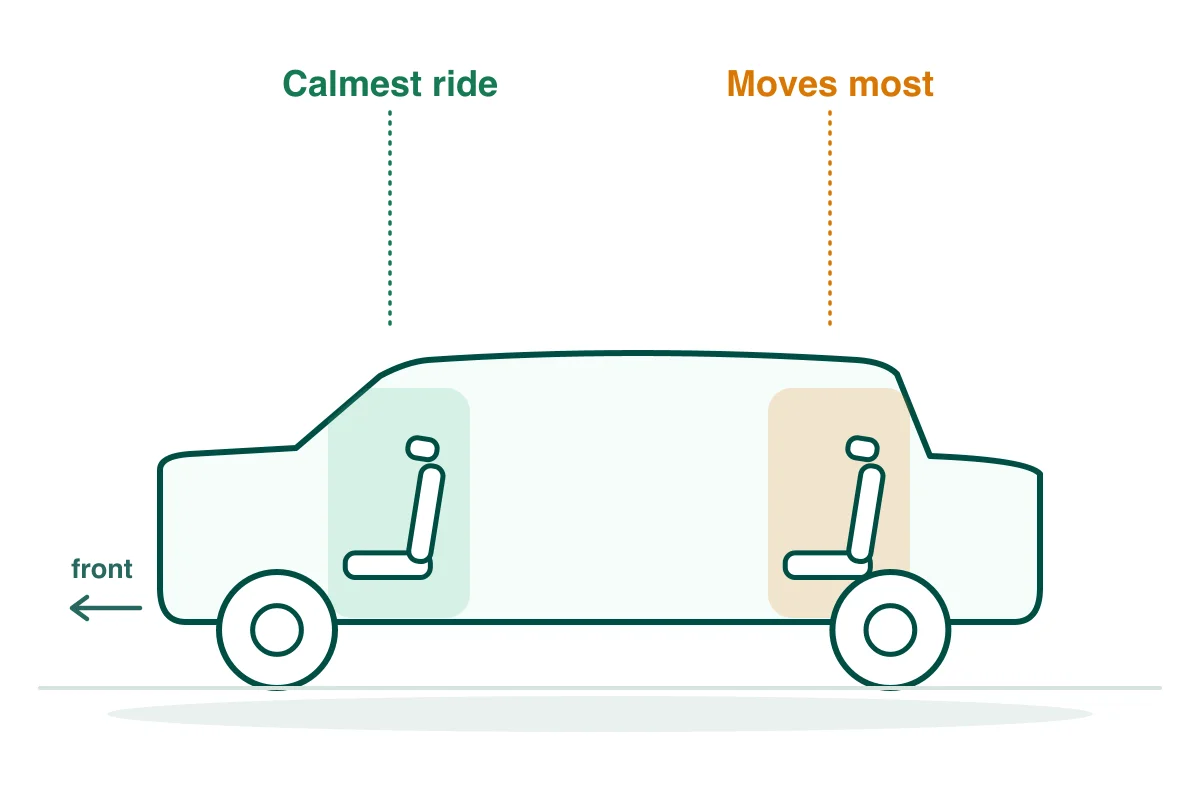
Front passenger seat with eyes on the horizon is still the steadiest spot. G-Vectoring works quietly in the background to smooth weight transfer, but rear-seat riders sensitive to motion should keep the cabin cool and ventilated, avoid looking down at phones, and watch the road ahead through the windshield.
Going on a drive in the Mazda CX-5? Set it up first
Set it up before you pull out, not at the first lay-by. Dizzout is a drug-free app that plays precisely calibrated audio through any headphones you already own, wired or Bluetooth, with relief in about 90 seconds. Free to try.
Before you need it: find out how prone you are
Take the free 2-minute testTwo minutes, no sign-up, and it ends with a drug-free plan to prepare.
Put it on your phone before you go
Free to try, no card needed. Or go straight to the App Store or Google Play.
 Scan to open on your phone
On a computer? Dizzout installs on your phone. Scan the code, or open dizzout.com/get on your phone and it'll take you straight to the right store.
Know someone who gets motion sick?
Send them the app that helps stop it, drug-free, in about 90 seconds, works with any headphones. Free to try.
What helps in the Mazda CX-5
- Sit up front when you can; the front passenger seat sits closer to the center of gravity and gives the clearest forward view
- Keep your eyes on the horizon or the road ahead rather than on a phone, book, or screen, which widens the eye-vs-inner-ear mismatch
- Crack a window or aim a vent at your face; cool, moving air is a simple, commonly cited comfort step
- For a carsick child, choose the second row over a cargo-area perch and keep their window view unobstructed
- Have the driver brake and corner gradually; smooth, predictable inputs let the CX-5's composed ride and GVC do their work
- Try Dizzout, a drug-free, screen-free sound therapy you can start the moment symptoms begin; most users feel better in about 90 seconds
The screens-away item on that list has a page of its own, with the trials attached: see the verdict on putting your phone away.
Frequently asked questions
Does the Mazda CX-5 really help with motion sickness?
Mazda's G-Vectoring Control is designed to reduce the abrupt weight shifts that can unsettle passengers, and JD Power notes it is often recommended for people prone to motion sickness. It is best thought of as a helpful design characteristic rather than a guarantee; some owners still report rear-seat bumpiness on rough roads.
What is G-Vectoring Control and how does it work?
It is a system that makes tiny, automatic adjustments to engine torque the moment you steer, shifting a small amount of weight onto the front wheels so the car corners more smoothly and your head sways less side to side. GVC arrived on Mazda in 2017, and the upgraded GVC Plus came to the CX-5 for 2019.
Why might someone still feel carsick in the back of a CX-5?
No feature eliminates motion sickness entirely. Rear-seat riders sit farther from the center of gravity and have a more limited forward view, and owners comparing the CX-5 with the smaller CX-30 still describe some bumpiness on rough roads. Sitting up front, watching the horizon, and getting fresh air all help.
Other car motion-sickness guides
Sources & further reading
- https://www.jdpower.com/cars/shopping-guides/what-is-mazda-g-vectoring-control-plus
- https://www.mazdausa.com/discover/g-vectoring-control
- https://www.hileymazdafortworth.com/blog/understanding-mazdas-g-vectoring-control-plus/
- https://mazdas247.com/forum/t/rear-seat-motion-sickness-cx-30-vs-cx-5.123878825/
Your next question, probably
Car sick on every single drive?
The graded plan that builds tolerance ride by ride
If that is not your question:
Based on publicly reported owner experiences and the vehicle's documented design characteristics, as of 2026. Vehicle and brand names are trademarks of their respective owners; Dizzout is not affiliated with or endorsed by them. Motion-sickness sensitivity varies by person, so this is informational, not a vehicle review or a substitute for a doctor's advice.