
Motion Sickness in the Mazda CX-30: Why It Happens & How to Prevent It
The Mazda CX-30 carries the same G-Vectoring Control Plus that earns its bigger sibling, the CX-5, a reputation for smooth weight transfer, yet it rides on a noticeably shorter wheelbase and a firmer, sportier suspension. That combination is why owner reports on whether the back seat feels settled are genuinely mixed rather than one-sided.
Subcompact SUV · ICE · Reader-reported motion-sickness risk: mixed, very person-dependent.
- Low
- Moderate
- High
- Very high
Risk levels summarise what passengers and riders commonly report, not measured testing.
Key facts
- The Mazda CX-30 is a subcompact SUV. It runs a combustion engine.
- Reader reports place it in the moderate band for motion sickness.
- 6 design factors are documented on this page as motion triggers in the Mazda CX-30.
- Best seat: Seat the most motion-sensitive rider up front with eyes on the horizon, where the steering response and forward view are clearest.
Try Dizzout free. Put it on your phone before you go, so it is there when you need it. Drug-free, any headphones.Free · works with any headphones · no account to try
Stop car sickness. Free to try, no card needed. Or go straight to the App Store or Google Play.
Why the Mazda CX-30 can trigger motion sickness
The CX-30 is a useful counterweight to the CX-5's "feature that helps" story: it shares Mazda's G-Vectoring Control Plus, which makes tiny torque adjustments to smooth weight transfer and reduce head sway, but it pairs that technology with a roughly 104-inch wheelbase and a deliberately taut, sporty suspension. Reviewers consistently praise its sharp, nimble handling and minimal body roll, while also noting the ride is on the firm side and can let jitters through on rough pavement. In owner forums, including direct CX-30-vs-CX-5 rear-seat comparisons, opinions on which feels steadier in back are inconclusive, so it's best framed as a sporty subcompact whose short wheelbase trades a little ride compliance for agility rather than a vehicle that "makes people sick."
- Shares Mazda's G-Vectoring Control Plus, which subtly adjusts torque to smooth weight transfer and reduce side-to-side head sway, but its effect is felt most up front
- Shorter wheelbase (around 104 inches) than the CX-5 can let road undulations translate into more pitch over the same stretch of road
- Reviewers describe the ride as firm and occasionally jittery on rough pavement, a trade-off for its sharp, nimble handling
- Taut suspension keeps body roll low in corners, which some sensitive riders find steadier than a floaty crossover
- Coupe-influenced styling with a high beltline and smaller rear glass can limit a back-seat rider's forward view of the road
- Rear-seat passengers are the ones who most commonly report queasiness, while drivers and front passengers rarely do
Best seat & setup in the Mazda CX-30
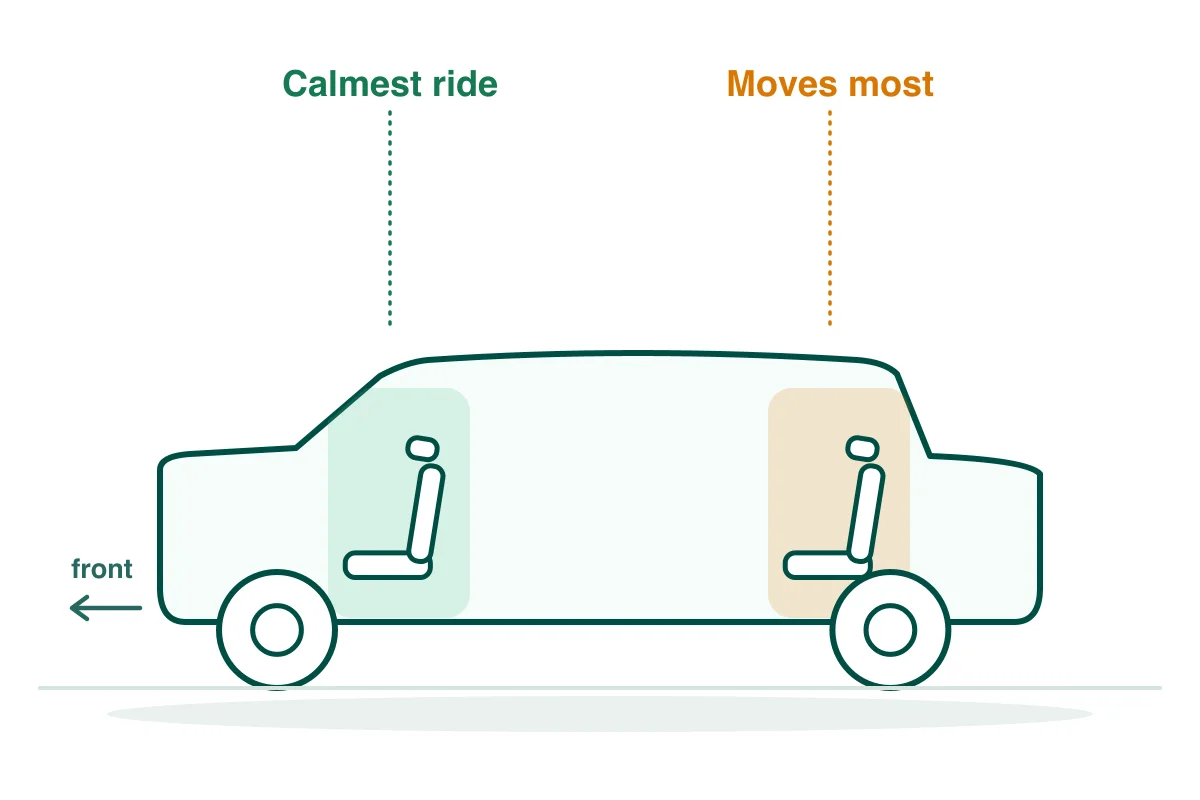
Seat the most motion-sensitive rider up front with eyes on the horizon, where the steering response and forward view are clearest. For rear-seat-sensitive passengers, owner comparisons are split on whether the larger CX-5 feels steadier than the shorter CX-30, so it can be worth test-driving both from the back seat; keep the cabin cool and ventilated and discourage looking down at phones.
Going on a drive in the Mazda CX-30? Set it up first
Set it up before you pull out, not at the first lay-by. Dizzout is a drug-free app that plays precisely calibrated audio through any headphones you already own, wired or Bluetooth, with relief in about 90 seconds. Free to try.
Before you need it: find out how prone you are
Take the free 2-minute testTwo minutes, no sign-up, and it ends with a drug-free plan to prepare.
Put it on your phone before you go
Free to try, no card needed. Or go straight to the App Store or Google Play.
 Scan to open on your phone
On a computer? Dizzout installs on your phone. Scan the code, or open dizzout.com/get on your phone and it'll take you straight to the right store.
Know someone who gets motion sick?
Send them the app that helps stop it, drug-free, in about 90 seconds, works with any headphones. Free to try.
What helps in the Mazda CX-30
- Put the rider who's prone to carsickness in the front passenger seat when possible, with eyes fixed on the road and horizon rather than the dashboard or a phone
- Keep phones, tablets, and reading out of the back seat while moving, since looking down widens the mismatch between what the eyes and inner ear sense
- Crack a window or aim a vent at face level; fresh, cool air is a simple, commonly recommended way to ease early queasiness
- On a CX-30, let GVC Plus do its job by driving smoothly, and brake and accelerate gradually so deceleration feels predictable to passengers
- If you're shopping, test-drive both the CX-30 and the longer-wheelbase CX-5 from the back seat, since owner reports on which feels steadier are inconclusive
- Dizzout is a drug-free, screen-free sound therapy you can start the moment symptoms begin; most users feel better in about 90 seconds. Over-the-counter options also exist, so follow the label or ask a pharmacist
The screens-away item on that list has a page of its own, with the trials attached: see the verdict on putting your phone away.
Frequently asked questions
Does the Mazda CX-30's G-Vectoring Control prevent motion sickness?
G-Vectoring Control Plus is a design characteristic that makes small torque adjustments to smooth weight transfer and reduce head sway, and Mazda tunes its cars around human balance. Owners generally find it helps the car feel composed, but forum discussions make clear it isn't a cure, especially for rear-seat riders, so treat it as a helpful feature rather than a guarantee.
Is the CX-30 or the CX-5 better if I get carsick in the back seat?
Owner comparisons, including direct CX-30-vs-CX-5 rear-seat threads, are inconclusive. Both share G-Vectoring Control Plus, but the CX-5 has a longer wheelbase that can soak up road undulations a little more, while the CX-30's shorter wheelbase and sportier tuning make it feel more agile. The most reliable answer is to test-drive both from the back seat.
Why do CX-30 owners report the ride feeling firm?
Reviewers and owners describe the CX-30 as firm and occasionally jittery on rough pavement because Mazda tunes it for sharp, nimble handling with minimal body roll. That firmness is a deliberate sporty trade-off; for some sensitive riders a well-controlled, low-roll ride feels steadier, while others prefer a softer-riding crossover.
Other car motion-sickness guides
Sources & further reading
Your next question, probably
Car sick on every single drive?
The graded plan that builds tolerance ride by ride
If that is not your question:
Based on publicly reported owner experiences and the vehicle's documented design characteristics, as of 2026. Vehicle and brand names are trademarks of their respective owners; Dizzout is not affiliated with or endorsed by them. Motion-sickness sensitivity varies by person, so this is informational, not a vehicle review or a substitute for a doctor's advice.