
Open water swimming and seasickness: what to expect
You can get seasick with no boat anywhere near you. Open water swimmers meet motion sickness in chop and rolling swell, and coaches know the pattern well: it shows up when you swim across the swell, sight too often, and lose every fixed reference with your face in the water.
A swimmer at the surface, no hull at all · Training swims and races, minutes to hours in swell · Reported seasickness risk: mixed, and it depends which part of the trip you are in.
- Low
- Moderate
- High
- Very high
Risk summarises what swimmers, coaches and race guidance commonly report for this activity, not a measurement of any one venue or day.
Key facts
- Coaches name chop, rolling swell, swimming parallel to shore across the swell, and over-frequent sighting as the specific triggers for seasickness while swimming.
- An estimated 25 to 30 percent of people are meaningfully prone to motion sickness, and swimmers who get carsick are the ones coaches warn to prepare.
- Marathon swimming guidance counts nausea as a race-ender: experienced swimmers have had long swims undone by an upset stomach rather than distance or cold.
Try Dizzout free. Put it on your phone before you go, so it is there when you need it. Drug-free, any headphones.Free · works with any headphones · no account to try
Stop seasickness on the water. Free to try, no card needed. Or go straight to the App Store or Google Play.
Why an open water swim sets people off
Swimming strips away the references that protect you on deck. Face down, there is no horizon at all, just water moving past goggles; the swell lifts and drops you on its own schedule; and the crawl stroke adds a steady head rotation to breathe. Coaching guidance singles out two specific aggravators: swimming parallel to the shore across the swell, so you are rolled sideways with every wave, and sighting too often, because repeatedly lifting and dropping your head disorients you more than it helps. Rough-water racing raises the dose further, which is why marathon swimming guidance counts nausea as a race-ender to train for, not an oddity.
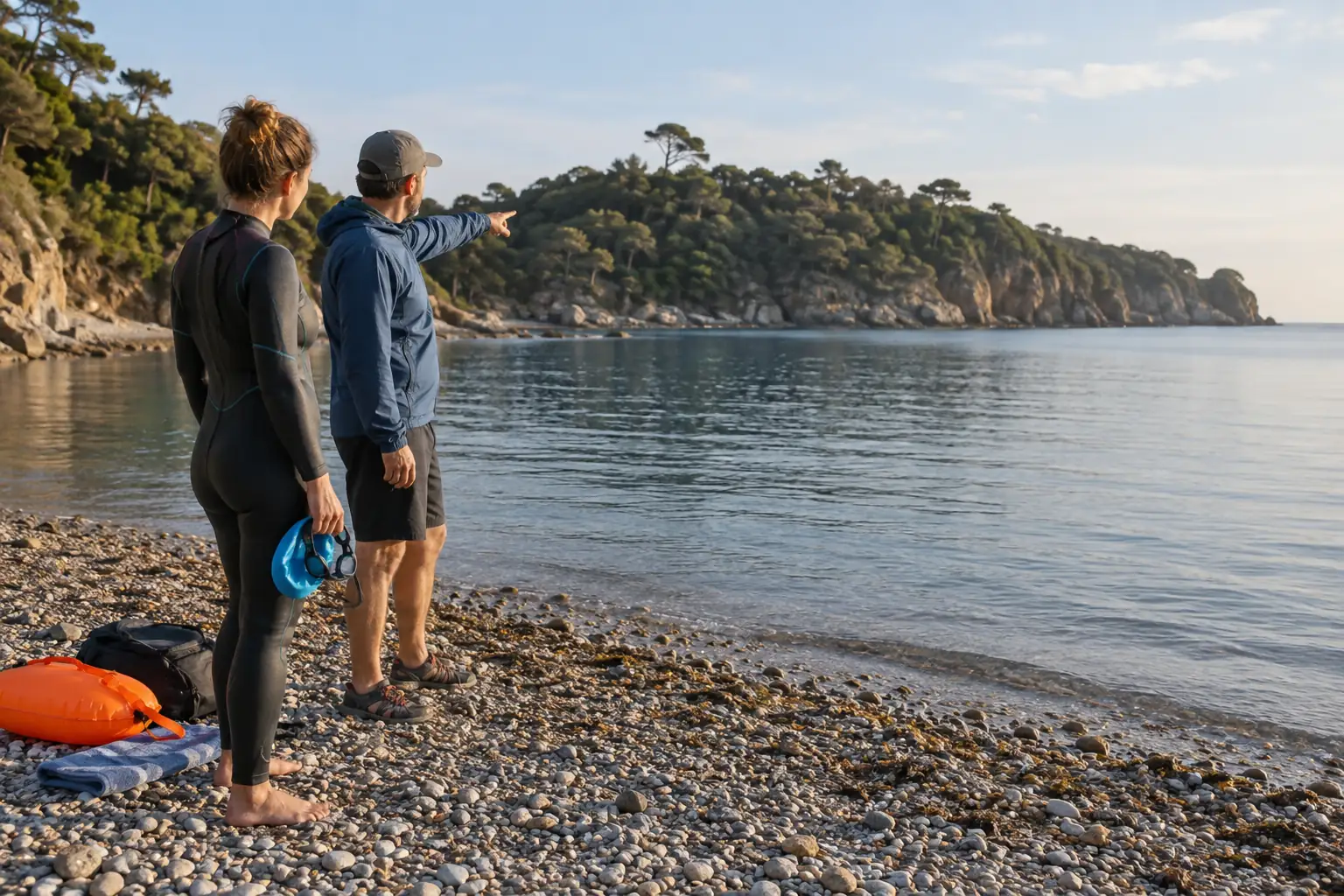
Flat water or swell: when it shows up
Flat water or swell is the real dividing line. In calm conditions almost nobody feels it: every motion is one your own stroke made, the open water version of the paddler's protection. In wind chop and rolling swell the water moves you instead, and the reports start, especially on courses that run along the beach across the swell rather than straight out through it. The fix coaches teach is not avoidance but dosage: swim in lively water little and often, and the tolerance builds.
How to swim through it
There is no midships to stand on, so position becomes technique. Settle into a rhythm of calm exhalation and smooth strokes, sight on a schedule, roughly every 8 to 10 strokes, rather than every time you feel lost, and when queasiness starts, stop, float, and fix your eyes on something genuinely static, a headland or a building on shore, not a bobbing buoy, while your breathing slows.
Going on an open water swim? Set it up first
Worth knowing before a swim: headphones do not work in the water, so this is a shore tool, not a mid-swim one. Have it on your phone for the walk down the beach and the minutes after you towel off. Dizzout is a drug-free app that plays precisely calibrated audio through any headphones you already own, with relief in about 90 seconds. Free to try.
Heading out on the water? Check the trip first
Check your tripFree, two minutes, and it scores the trip you actually have ahead.
Put it on your phone before you go
Free to try, no card needed. Or go straight to the App Store or Google Play.
 Scan to open on your phone
On a computer? Dizzout installs on your phone. Scan the code, or open dizzout.com/get on your phone and it'll take you straight to the right store.
Know someone who gets motion sick?
Send them the app that helps stop it, drug-free, in about 90 seconds, works with any headphones. Free to try.
What helps on this trip
- Sight on a schedule, every 8 to 10 strokes, and glance at something fixed on land rather than the buoys, which bob with the same swell you do.
- If it starts, stop and float, eyes on a static point ashore, and let a long slow exhale settle you before swimming on.
- Train the tolerance deliberately: coaching guidance is to swim in conditions other than flat calm, little and often, rather than meeting real swell for the first time on race day.
- Plan courses out-and-back through the swell where you can, and save the along-the-beach route across it for calmer days.
- Sound therapy is a beach and boat tool here, never a mid-swim one. Dizzout is drug-free and works with any headphones, but headphones do not work in the water: use it before you get in and after you get out.
For what actually holds up under testing, see the remedy verdicts, and for the water itself rather than the boat, how rough your sea usually is. Anything you take before travelling is a question for a pharmacist or doctor.
Frequently asked questions
Why do I feel seasick while swimming in open water?
Because swimming removes every fixed reference and replaces it with motion you did not make. With your face in the water there is no horizon, the swell lifts and rolls you on its own rhythm, and the breathing rotation keeps your head moving. Coaches point at two multipliers: swimming across the swell, which rolls you sideways with every wave, and sighting too often, which whips your head up and down. In flat water the problem largely disappears, which is the clue that the swell, not the swimming, is the trigger.
How do open water swimmers get rid of nausea mid-swim?
The standard coaching sequence: stop trying to push through it, float or tread water, and put your eyes on something genuinely still, a point on the shoreline rather than a buoy, while you slow your breathing with long exhales. Then swim on with a calmer rhythm and less frequent sighting, around every 8 to 10 strokes. If the course allows, turning to swim through the swell rather than across it helps too. Pushing on face down in the same rolling water rarely improves anything.
Can I train myself out of getting seasick while swimming?
Coaches say largely yes, by dosing the exposure. The guidance from open water and marathon swimming sources is to swim in lively conditions little and often rather than only in flat calm, so your balance system learns rolling water gradually instead of meeting it on race day. Experienced swimmers still get caught in genuinely rough conditions, and the same sources are honest that a minority stay sensitive, but regular rough-water practice moves most swimmers a long way.
Other trips and excursions
Related
- Seasickness: the full guideWhy ships do it, the steadiest cabin, and a survival kit for the crossing.
- Is your sea rough? Sea by seaEvery crossing in one table, roughest first, each with a month-by-month page.
- Cruise ships & motion sicknessNamed ships sorted by how much they move, grouped by cruise line.
- Feeling it right now: the 90-second stepsThree steps over 90 seconds, with a timer that waits if you lock the screen.
Sources & further reading
- https://www.wildswimmingcornwall.co.uk/blog/sea-motion-sickness-whilst-swimming
- https://www.openwaterswimming.com/how-to-prepare-for-nausea-vomiting-and-motion-sickness-in-open-water-swimming/
- https://forum.slowtwitch.com/t/seasickness-and-dizziness-during-open-water-swims/642480
- https://www.220triathlon.com/training/injuries/how-to-prevent-motion-sickness-and-nausea-when-swimming
Your next question, probably
Feeling rough right now?
The 60-second protocol: your eyes, the air and your breathing
If that is not your question:
Written from operator guidance, marine, aviation and specialist sources, and published passenger and participant reports as of September 2026. Risk levels describe a kind of trip, not any particular operator's craft, and conditions on the day matter more than the category does. Operator and brand names are trademarks of their respective owners; Dizzout is not affiliated with or endorsed by them. Sensitivity varies from person to person; this page is informational and not medical advice.