
Night vs day driving: when is car sickness worse?
For a passenger who stays awake, night is usually worse. Darkness deletes the two things that protect you in daylight: a visible horizon and a readable road ahead, so every bend and brake arrives unannounced while sweeping headlights add moving light with no matching motion. But there is a genuine flip side: if you can sleep, night becomes the better shift, because a sleeping brain stops fighting the mismatch entirely, and health guidance lists sleeping among the most effective responses to motion sickness. The verdict depends on one question: will you be awake for it?
Plenty of people notice their car sickness has a schedule: fine on the morning drive, miserable on the same road after dark. That is not imagination. The daylight version of the trip gives your brain a continuous feed of anticipatory information, and the night version cuts the feed while the motion stays identical.
At the same time, some families deliberately drive through the night with their queasiest passenger aboard and swear by it. Both camps are right, and the difference is sleep. Here is how darkness changes the motion-sickness equation, in both directions.
Whichever option you pick, Dizzout is a drug-free backup for the moment nausea starts: precisely calibrated sound on any headphones, free to try on iOS and Android.
Free to try, no card needed. Or go straight to the App Store or Google Play.
Night vs day driving for a motion-sick passenger
| Factor | Day | Night |
|---|---|---|
| Horizon reference | Available, does quiet stabilising work | Gone |
| Road anticipation | Bends and braking visible early | Headlight range only, surprises frequent |
| Visual noise | Low | Sweeping headlights, glare, smear in rain |
| Fatigue factor | Lower | Higher, lowers the nausea threshold |
| Sleep opportunity | Poor | The big advantage if you can take it |
| Traffic smoothness | Congestion and stop-go likely | Often emptier, steadier roads |
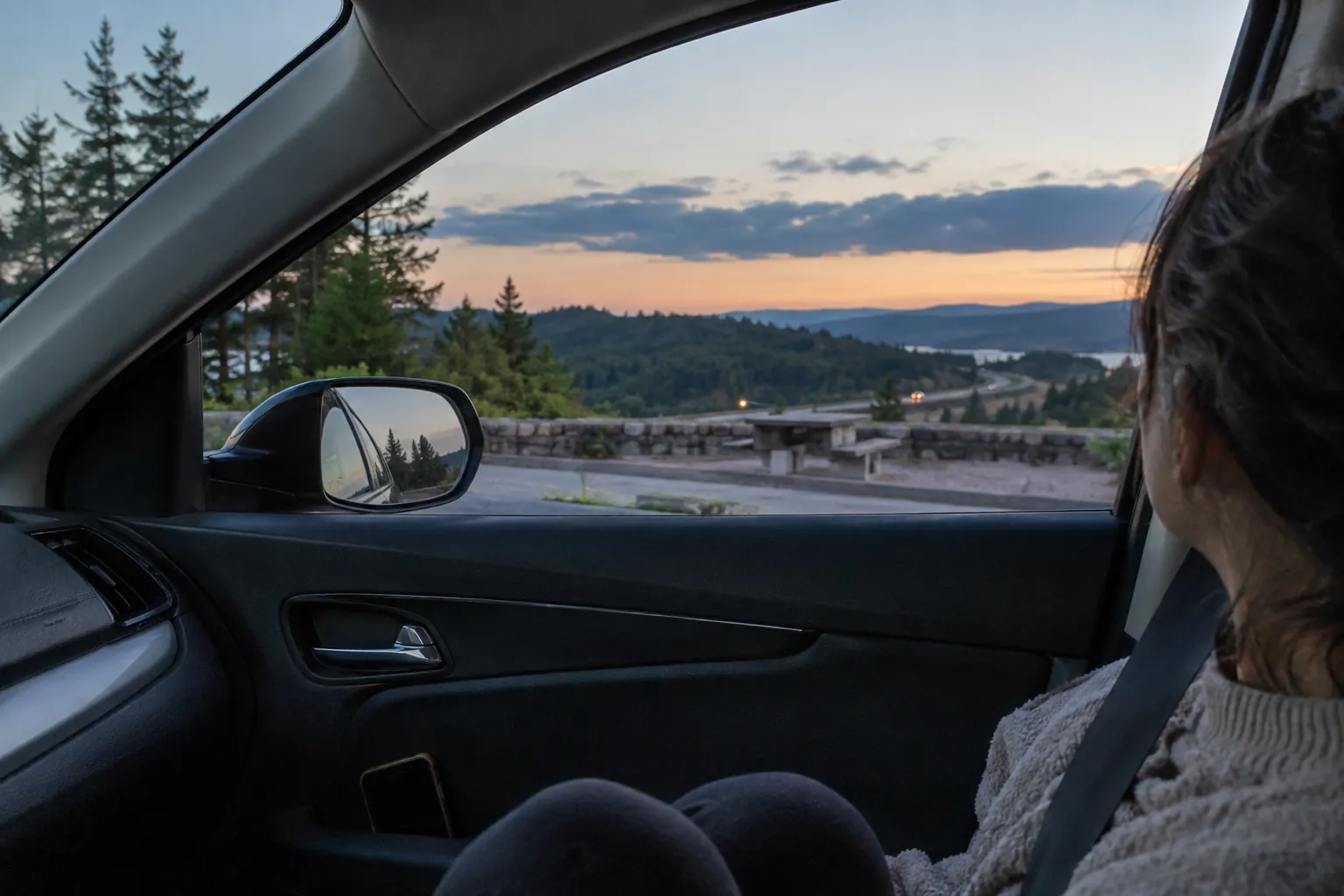
What darkness takes away
In daylight, a front or window-seat passenger constantly, half-consciously reads the road: that bend is coming, the traffic is bunching, we are about to slow. Every prediction that comes true is a small vote of confidence between what you see and what you feel. The stable horizon does quiet work too, giving your balance system a fixed reference while the car moves around it. Guidance from health agencies like the CDC leans on exactly these levers: look at the horizon, sit where you can see.
At night the horizon is gone and the road exists only as far as the headlights. Bends announce themselves seconds late, braking arrives as a surprise, and your inner ear feels everything while your eyes verify almost nothing. The mismatch that motion sickness runs on gets wider on the same road at the same speed.
What darkness adds
Night driving does not just remove cues, it adds confusing ones. Oncoming headlights sweep light across the cabin, bright points move against the windows, and in rain the wet windscreen turns every light into smeared motion. Your visual system reports plenty of movement, just not the movement your body feels. For sensitive passengers this light-without-motion is its own provocation, which is why the misery often peaks on busy wet roads after dark.
Fatigue stacks on top. Late-evening travel usually means a tired brain, and tiredness reliably lowers the threshold at which queasiness starts. The same passenger, the same road and the same driver can produce a different outcome at 10pm than at 10am for that reason alone.
The sleep exception, and how to use it
Sleep changes everything. A sleeping passenger has closed eyes, a still, supported head, and a brain that has stopped comparing sensory streams: three of the strongest protections there are, all at once. This is why overnight drives can be the calmest option for people who reliably drop off in cars, and why lying down and sleeping appear in official advice for easing motion sickness.
If you want to use the exception, engineer it honestly. Travel at your normal sleep time rather than hoping to doze at dusk, bring a neck pillow so your head does not loll with every curve, recline the seat as far as safety allows, and settle in before the winding section starts rather than after the nausea does. If you know you cannot sleep in cars, do not gamble on it: schedule the drive for daylight and claim a seat with a view instead.
When to use which
Drive in daylight when the queasy passenger will be awake either way: the visible road and horizon are worth more than empty night lanes. Choose night when that passenger reliably sleeps in cars, and set the sleep up deliberately with timing, a supported head and a reclined seat. If you are caught awake in the dark and feeling it, act early: cool air on your face, eyes closed or fixed far up the road where the headlights reach, no phone, and a stop at the next safe place rather than twenty minutes of pushing through.
Try drug-free motion sickness relief
Try Dizzout Free
Free to try on iOS and Android · ~90 seconds · works on any headphones.
Frequently asked questions
Why do I get carsick at night but not during the day?
Daylight gives your brain two protections that darkness removes: a stable horizon to anchor your balance system, and a readable road that lets you anticipate every bend and brake before you feel it. At night the same motion arrives unannounced, while oncoming headlights add moving light that matches nothing your body feels. Add the fatigue of evening travel, which lowers the nausea threshold, and the same route can play out very differently after dark.
Does closing my eyes help in a car at night?
Often, yes. With your eyes closed the visual stream stops arguing with your inner ear entirely, which is why shutting your eyes and lying back appear in standard motion sickness advice. At night you lose less by closing them, since the useful visual anchors are gone anyway and what remains is mostly glare and sweep. If closed eyes alone are not enough, combine them with a still, supported head and cool moving air.
Is driving through the night with a carsick child a good idea?
Many families do it precisely because a sleeping passenger is a protected one, and it works when the child genuinely sleeps through. Weigh it against the full picture, including the driver's own alertness and rest, which matters more than any motion consideration, and talk to your paediatrician or pharmacist before adding any medication to the plan. If the child tends to stay awake in the car, darkness usually makes things worse, not better, and a daylight drive with a window view is the safer bet.
Night is kind to sleepers and unkind to everyone else. Decide which passenger you have, then pick the shift: daylight and a windscreen view for the awake, a pillow and a planned bedtime on wheels for the rest.
Related comparisons
- Car sickness: the full guide
- Does watching the horizon work? The verdict
- Does closing your eyes work? The verdict
- Road trip nausea: long-drive strategies
- All motion sickness comparisons
This page is general information, not medical advice; reactions to motion vary by person and conditions. Driver fatigue is a serious safety issue in its own right: plan night drives around the driver's rest first, and talk to a doctor or pharmacist about medication questions.