Greek island ferries vs flying: which should you book?
In summer the Aegean is windy by design: the meltemi blows hardest in July and August, and the fast ferries that hop between the Cyclades can turn into genuinely rough rides. If you are prone to seasickness, fly the long legs where an airport exists (Santorini, Mykonos, Crete, Paros and Milos all have one) and save ferries for short hops on big, conventional ships. If a ferry is unavoidable, the large slow boat beats the fast catamaran on comfort almost every time, and morning sailings often beat afternoon ones because the wind tends to build through the day.
Island hopping looks idyllic until the meltemi shows up. This dry northern wind is a fixture of the Greek summer, strongest in July and August, exactly when most people travel, and it turns the open stretches between the Cyclades into short, steep seas. Every season, travellers who booked a fast catamaran to save an hour spend the crossing regretting it, and the stories that make the news are almost always from those smaller high-speed boats.
The good news is that this is a choice you can actually plan around. Several of the most-visited islands have airports, ferries vary enormously in how they handle wind, and the sailing time of day matters. Here is the honest comparison for someone whose stomach gets a vote.
Whichever option you pick, Dizzout is a drug-free backup for the moment nausea starts: precisely calibrated sound on any headphones, free to try on iOS and Android.
Free to try, no card needed. Or go straight to the App Store or Google Play.
Greek island ferries vs flying for a seasickness-prone traveller
| Factor | Ferries | Flying |
|---|---|---|
| Exposure to rough water | Hours, worst in July and August meltemi | None; short flights over it |
| Best and worst versions | Big slow ferry decent; fast cat in wind is the worst case | Jet smooth; small prop hops bumpier in wind |
| Cancellation risk in wind | Real, fast craft first | Lower |
| Horizon view and fresh air | Open decks on big ferries; often none on fast cats | Window seat view, sealed cabin |
| Coverage | Every inhabited island | Only islands with airports |
| Cost and luggage | Cheaper, generous luggage, vehicles possible | Pricier per leg, standard airline limits |
| Time-of-day effect | Morning sailings often calmer; wind builds through the day | Minor |
Why summer crossings get rough
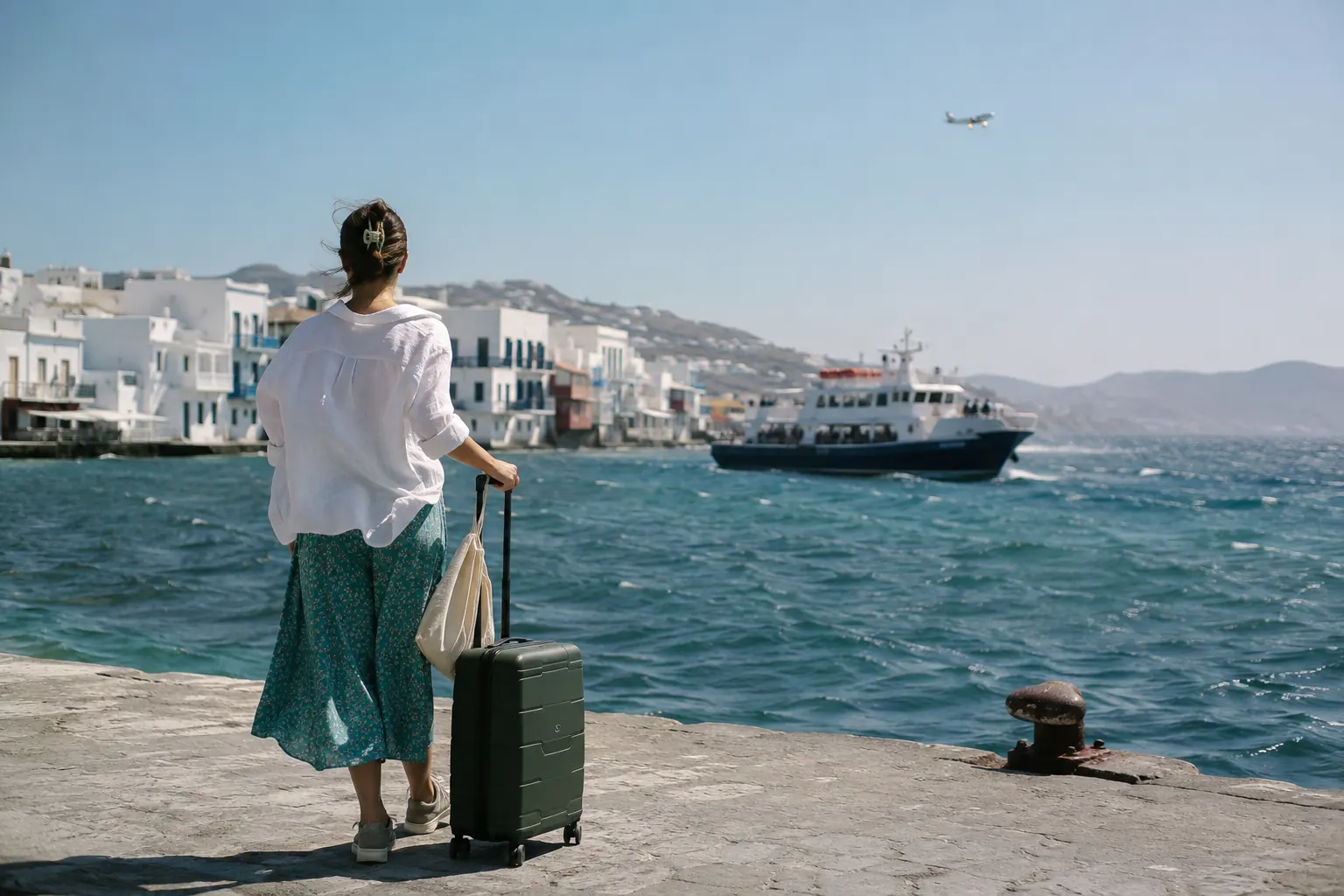
The meltemi is a seasonal pressure-driven wind that funnels down the Aegean, and it can blow hard for days at a stretch. Because many inter-island runs cross open water with long fetch, the wind builds short, steep waves rather than gentle swell. That wave shape is the unfriendly kind for inner ears: quick repeated motion with no settling rhythm. Our Aegean Sea page covers the seasonal pattern in more detail.
Wind this strong also disrupts schedules. High-speed services are the first to be cancelled or diverted when it blows, which strands tight itineraries. If your trip has a fixed flight home, building slack around ferry days is not pessimism, it is how locals plan.
Fast catamaran vs big ferry, and why it matters
The boats on Greek routes span two very different rides. Large conventional ferries are heavy, deep-hulled ships that push through chop and carry vehicles, and on them a windy day is unpleasant but usually manageable. High-speed catamarans and hydrofoils are light craft that ride the surface: faster, more frequent, and far livelier in the same sea. Passengers are typically kept in enclosed cabins on the fast boats, often without open deck access, which removes the horizon view and fresh air that help most.
If you get seasick and must sail on a windy day, the slow boat is the better hour even though it is a longer one. On calm days the difference shrinks and the fast boat is a fine choice.
Where flying fits in an island-hopping plan
Santorini, Mykonos, Crete, Paros and Milos all have airports with regular connections, and several other islands do too. A common motion-friendly pattern: fly into one hub island, take short big-ferry hops to neighbours in the same group, and fly out of another hub rather than backtracking across open water. The longest, most exposed legs, like the run from Athens across to Santorini, are exactly the ones where a 40-minute flight replaces hours at sea.
Flights cost more per leg and carry less luggage flexibility, and small-aircraft hops have their own bumps on windy days. But the total time exposed to provocative motion is a fraction of the ferry equivalent, and schedules are less likely to be reshuffled by the wind.
When to use which
Fly the long open-water legs when you are prone to seasickness and the island has an airport, especially in July and August when the meltemi peaks. Use ferries for short hops within an island group, favour the big conventional ships over fast catamarans, lean toward morning departures, and keep a flexible day in the plan for wind cancellations. If you are already on a ferry and feeling it, get outside on deck if the ship allows it, watch the horizon, and stay out of enclosed lounges where the visual world sways with the boat.
Try drug-free motion sickness relief
Try Dizzout Free
Free to try on iOS and Android · ~90 seconds · works on any headphones.
Frequently asked questions
When is the meltemi season and how bad is it?
The meltemi is the dry northerly wind of the Greek summer. It can appear from late May and lingers into September, with July and August the strongest months. It ranges from a pleasant breeze to multi-day blows that cancel fast-ferry sailings and make open crossings genuinely rough. It is a pattern, not a constant: many summer days are calm, so checking the wind forecast a day or two ahead of a crossing is the single most useful habit.
Are the fast ferries between the islands worse for seasickness?
In wind, yes, and by a wide margin. High-speed catamarans are light craft that feel a short Aegean chop sharply, and passengers usually sit in enclosed cabins without deck access or a proper horizon view. Big conventional ferries are slower but heavier and steadier, with open decks. On calm days the fast boats are perfectly comfortable and save real time, so the rule is about windy days, not fast boats in general.
Which Greek islands can I fly to instead of taking a ferry?
Santorini, Mykonos, Crete, Paros and Milos all have airports with scheduled service, and there are more, including Rhodes, Corfu and several smaller islands with seasonal routes. A practical motion-friendly itinerary flies the long legs between groups and uses short big-ferry hops for the rest. Routes and seasonal schedules change, so verify current connections when you plan.
The Aegean rewards planning. Fly across the long, windy gaps, sail the short ones on big ships in the morning, respect the meltemi in July and August, and island hopping with a sensitive stomach is entirely doable. The trip that goes wrong is almost always the same one: a fast catamaran, a windy afternoon, and no plan B.
Related comparisons
- Is the Aegean Sea rough? The seasonal guide
- Ferry vs cruise ship for seasickness
- Morning vs afternoon boat trips
- How to not get seasick: the full plan
- All motion sickness comparisons
This page is general travel information, not medical advice; reactions to sea conditions vary by person and by day. Ferry schedules, airport routes and wind conditions change, so check operators and forecasts before booking. Product and company names are trademarks of their respective owners; Dizzout (Kinda Smart Inc.) is not affiliated with them.