
Whale watching boat and seasickness: what to expect
Whale watching is a high-risk trip for a reason most passengers do not see coming: the boat stops. It cruises out fine, then sits in open swell at a sighting, and that is the moment people commonly report going from fine to unwell.
Large catamaran, monohull tour boat or fast RIB · 2.5 to 4 hours in open coastal water · Reported seasickness risk: commonly reported as a strong trigger.
- Low
- Moderate
- High
- Very high
Risk summarises what passengers, crews and published marine guidance commonly report for this kind of craft, not a measurement of any one operator's boat.
Key facts
- Whale watching trips typically run 2.5 to 4 hours in open water beyond the harbour, with long stops at sightings.
- Operators state that boats roll when stopped in wavy seas, and stopping is the design of the trip rather than an interruption to it.
- The upper deck and the enclosed cabin are the two spots most commonly reported as worse; midships on the open main deck is the calmer one.
Try Dizzout free. Put it on your phone before you go, so it is there when you need it. Drug-free, any headphones.Free · works with any headphones · no account to try
Stop seasickness on the water. Free to try, no card needed. Or go straight to the App Store or Google Play.
Why a whale watching boat sets people off
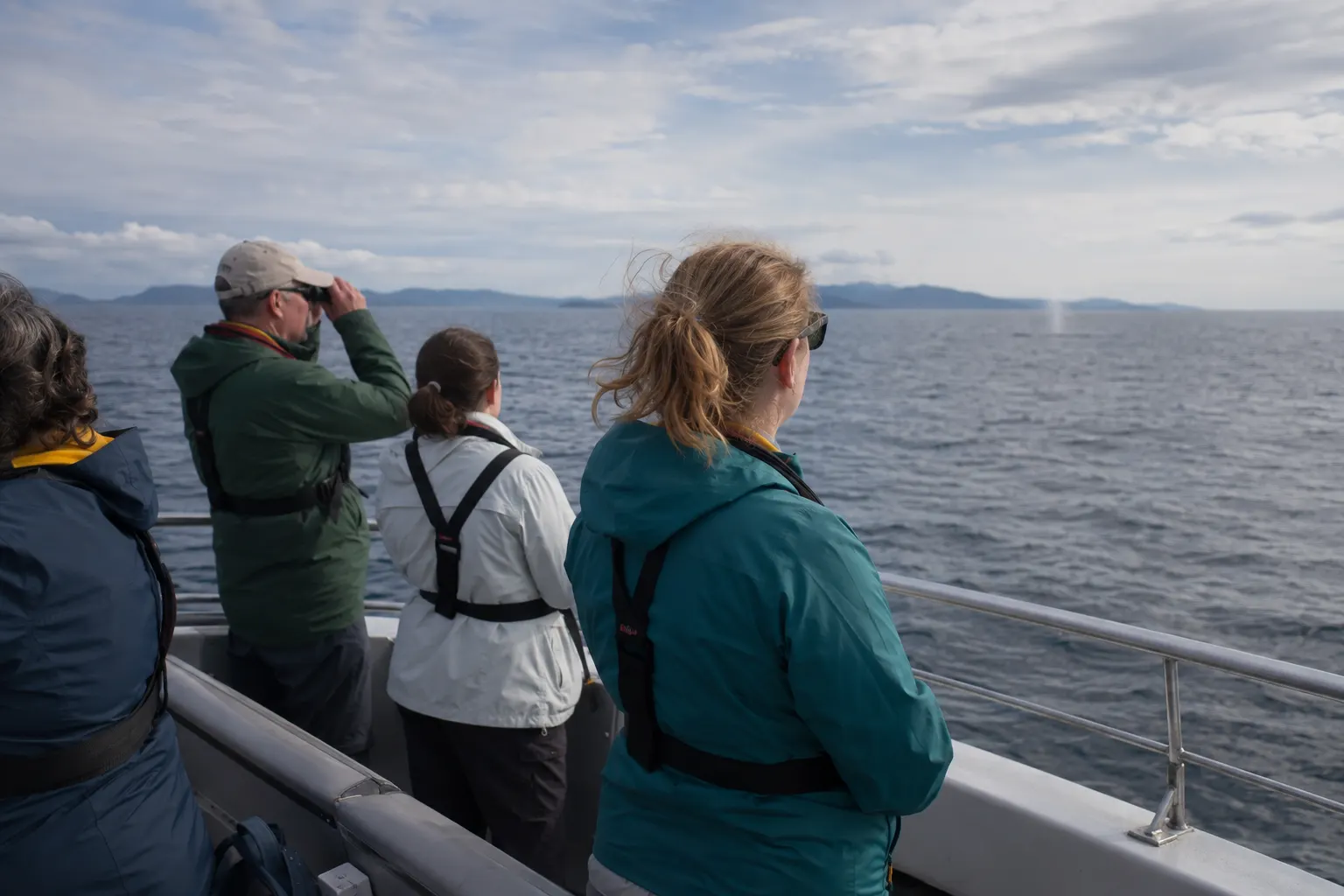
The outbound run is usually the comfortable part. At a sighting the boat idles or stops, a hull without forward drive lies beam on to the swell, and it rolls. One Icelandic operator says exactly this in its own FAQ: boats can roll when stopped in wavy seas, and that is when motion-sensitive passengers get sick. The second trigger is what everyone does at a sighting. Heads go down over a camera or a phone, tracking a whale that surfaces and vanishes, which is a small moving target rather than a fixed horizon.
Stopped or underway: which part is worse
Worse stopped. A firsthand account on the Cruise Critic boards runs the classic pattern: fine while the boat was moving, sick once it stopped to watch whales in the swell.
Where to be on board
Main deck, midships, in open air with the horizon in view. Skip the enclosed cabin and the high upper deck, where the roll is amplified. When the boat stops, keep your eyes moving between the whales and the horizon rather than down at a camera screen.
Going on a whale watching boat? Set it up first
You will not want to be setting up an app once the boat is moving. Dizzout is a drug-free app that plays precisely calibrated audio through any headphones you already own, wired or Bluetooth, with relief in about 90 seconds. Free to try.
Heading out on the water? Check the trip first
Check your tripFree, two minutes, and it scores the trip you actually have ahead.
Put it on your phone before you go
Free to try, no card needed. Or go straight to the App Store or Google Play.
 Scan to open on your phone
On a computer? Dizzout installs on your phone. Scan the code, or open dizzout.com/get on your phone and it'll take you straight to the right store.
Know someone who gets motion sick?
Send them the app that helps stop it, drug-free, in about 90 seconds, works with any headphones. Free to try.
What helps on this trip
- Take the main deck midships and stay outside. The upper deck looks like the better view and moves considerably more.
- At a sighting, alternate: whale, horizon, whale. Long stretches down a camera viewfinder while the boat rolls is the common trigger.
- If the operator runs both a large boat and a fast RIB, the bigger hull is the steadier platform at a stop. Dive guidance makes the same recommendation for the same reason.
- Get air on your face. Open deck, wind and a horizon are the three things that cost nothing.
- If it starts anyway, put your earbuds in. Dizzout is drug-free sound therapy designed to help after symptoms start, and it works with any headphones.
For what actually holds up under testing, see the remedy verdicts, and for the water itself rather than the boat, how rough your sea usually is. Anything you take before travelling is a question for a pharmacist or doctor.
Frequently asked questions
Will I get seasick whale watching?
Some passengers do, and the reports cluster at a predictable moment. Whale watch boats leave harbour and cross open coastal water, then stop or idle at a sighting, often for a long stretch. Operators state that boats roll when stopped in wavy seas and that motion-sensitive passengers get sick in exactly those conditions. If the forecast is calm and you stay midships on the open deck with the horizon in view, most people are fine.
Why do people get sick when the boat stops to watch whales?
A boat with no forward drive tends to swing beam on to the swell and roll, and a slow side-to-side roll is the motion people tolerate worst. Underway, the hull is driven through the water on a chosen heading and the motion is steadier and more predictable. Firsthand accounts follow that pattern closely: fine on the way out, unwell once the engines came back to idle at the whales.
Where should I sit on a whale watching boat to avoid seasickness?
Main deck, midships, outside. Motion is amplified the higher and the further from the centre you go, so the top deck rides worse than the main one, and the bow rides worse than the middle. The enclosed cabin is the other place to avoid: it is out of the wind but it also takes away the horizon, which is the reference your balance system wants most.
Other trips and excursions
Related
- Seasickness: the full guideWhy ships do it, the steadiest cabin, and a survival kit for the crossing.
- Is your sea rough? Sea by seaEvery crossing in one table, roughest first, each with a month-by-month page.
- Cruise ships & motion sicknessNamed ships sorted by how much they move, grouped by cruise line.
- Feeling it right now: the 90-second stepsThree steps over 90 seconds, with a timer that waits if you lock the screen.
Sources & further reading
- https://husavikadventures.is/faq/seasickness-common-whale-watching-tours/
- https://boards.cruisecritic.com/topic/2862013-seasickness-on-whale-watching-excursion/
- https://www.victoriawhalewatching.com/preventing-sea-sickness-the-whale-watchers-guide/
- https://newportwhales.com/sea-sick-prevention-while-whale-watching.html
- https://montereywhalewatching.com/blog/10-tips-to-prevent-seasickness/
Your next question, probably
Will the water itself be rough?
Sea by sea, month by month
If that is not your question:
Written from operator guidance, marine, aviation and specialist sources, and published passenger and participant reports as of September 2026. Risk levels describe a kind of trip, not any particular operator's craft, and conditions on the day matter more than the category does. Operator and brand names are trademarks of their respective owners; Dizzout is not affiliated with or endorsed by them. Sensitivity varies from person to person; this page is informational and not medical advice.