Spinning rides vs roller coasters: which makes you sicker?
For most people, spinning rides are the stronger sickness machine, and being fine on coasters while teacups wreck you is one of the most common patterns in any theme park. A coaster delivers big forces in brief, varied bursts, with the track visible ahead and your eyes agreeing with your body most of the way. A spinning ride delivers one thing continuously: sustained rotation, and the moment you tilt your head during a spin, the inner ear's signals cross in a way that is provocative enough that researchers use spinning chairs on purpose when they need to make people dizzy. The two ride families are simply different experiments on your balance system.
Theme park groups sort themselves quickly: the ones who ride every coaster but refuse the teacups, and the ones who cannot understand how a 70-mile-an-hour drop is fine while a gentle-looking carousel of spinning tubs is not. The split is real and mechanical, not a matter of nerve.
Understanding which family of ride does what to your inner ear is genuinely practical: it predicts which lines are safe for you, explains the queasy hour after a spinning ride, and beats the vague strategy of judging rides by how fast they look. For verdicts on specific famous rides, our ride guides cover them one by one.
Whichever option you pick, Dizzout is a drug-free backup for the moment nausea starts: precisely calibrated sound on any headphones, free to try on iOS and Android.
Free to try, no card needed. Or go straight to the App Store or Google Play.
Spinning rides vs roller coasters for motion sickness
| Factor | Spinning rides | Roller coasters |
|---|---|---|
| Core stimulus | Sustained rotation, cross-axis head tilts | Brief, varied forces along a track |
| Visual agreement | World whirls, body says steady | You see each drop before you feel it |
| Duration of provocation | Continuous for the whole cycle | Seconds at a time |
| Aftereffects | Lingering turning sensation is common | Usually fade fast |
| Rider control | Head position; skip the self-spin wheel | Row choice, head back, ride selection |
| Typical verdict for the prone | The ones to respect | Often fine, judge by roughness not height |
What spinning does that dropping does not
Your inner ear's rotation sensors respond to changes in spin, not to steady rotation itself. A few seconds into a constant spin, they settle and report calm while your eyes watch the world whirling past: an immediate conflict. Then comes the real trap: tilt your head during the spin, glance down, lean toward a friend, and the rotation is suddenly sensed across a different axis, producing a wave of tumbling sensation that matches nothing you see. That head-tilt-while-spinning combination is among the most reliably nauseating stimuli known, which is exactly why rotating chairs are the classic tool when researchers need to induce dizziness deliberately.
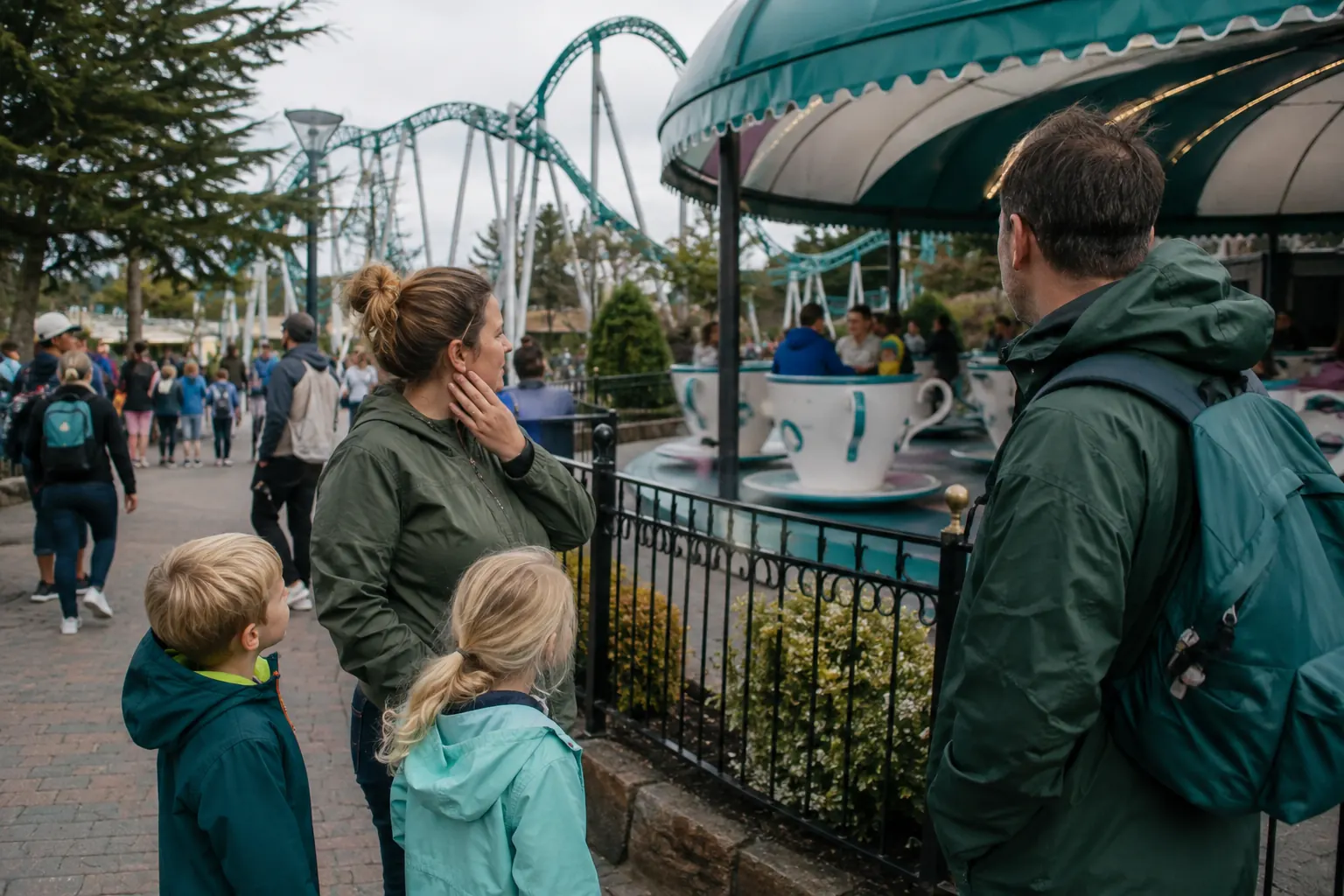
Spinning rides, teacups, waltzers, gravity spinners, serve that combination continuously for a minute or more, and many let riders spin themselves faster. The aftereffects linger too: stepping off with the world still gently turning is your rotation sensors recalibrating.
Why coasters get away with so much more
A coaster's forces are larger but briefer and better labelled. Each drop, loop and turn lasts a second or two, arrives with the track visible ahead, and comes packaged with matching visuals: you see the drop, then feel the drop, in that order. Predictable, visually confirmed motion is the kind brains tolerate best, which is why many people scream happily through forces that dwarf anything the teacups produce.
Coasters are not free passes. Rough tracks that shake the head, long sequences of tight helices, and especially spinning coaster cars that add rotation to the mix push some riders over. Riding at night or in the back row reduces the visual preview and catches others. But as a family, coasters provoke less nausea per minute than dedicated spin rides, and the difference shows up in who is queasy at lunch.
Using the split to plan a park day
Know your family of enemy. If spinning is your weakness, the flat rides that rotate continuously, and any coaster car that spins independently, deserve more caution than the tallest track in the park; if you must ride them, keep your head pressed back against the rest and fixed upright, which blunts the cross-axis trap, and skip the self-spin wheel entirely.
Sequence matters as well. Spinning aftereffects accumulate across repeated rides, so alternate provocative rides with calm ones rather than marathoning the spin section, and give yourself ground time when the world keeps moving after you step off. Eat lightly and drink water through the day; heat and dehydration lower everyone's threshold. And if the aftereffects last well beyond the park day, our pages on dizziness cover when lingering symptoms are worth a doctor's look.
When to use which
Use the ride family, not the scare factor, to predict your day: a towering smooth coaster is often kinder than a modest ride that rotates for ninety seconds. If spinning is your weakness, ride those early or not at all, never back to back, with your head pinned to the rest, and let the self-spin wheel stay untouched. If coasters are your weakness instead, favour smooth modern tracks over rough ones, ride in daylight, and keep your head back through transitions. Either way, alternate intense rides with calm ones and let the ground settle between rounds.
Try drug-free motion sickness relief
Try Dizzout Free
Free to try on iOS and Android · ~90 seconds · works on any headphones.
Frequently asked questions
Why can I ride roller coasters but not the teacups?
Because they test different things. A coaster's forces are big but brief, varied and visually previewed: you see the drop coming and your eyes agree with your body through most of it. The teacups deliver sustained rotation, and every head tilt during a spin crosses your inner ear's axes in a way that reliably produces nausea; researchers literally use spinning chairs when they need to make people dizzy on purpose. Being coaster-proof but teacup-vulnerable is the normal version of human wiring.
Why do I stay dizzy after spinning rides stop?
Sustained rotation pushes your rotation sensors into a settled state, and when the ride stops they report the opposite: a turning sensation with no turn. That aftereffect, the world gently rotating for a minute after you step off, is normal recalibration, and it stacks if you marathon spin rides back to back. Give it ground time, fix your eyes on something distant and still, and space the provocative rides out. If dizziness persists for hours, take a longer break.
Are spinning roller coaster cars the worst of both worlds?
For prone riders, close to it. They combine a coaster's speed and track forces with free rotation of the car, which removes the visual preview, since you may be facing backwards into every drop, and adds the sustained-spin stimulus on top. Riders who handle standard coasters comfortably often name the spinning-car versions as the ride that finally got them. If motion sickness is in your picture at all, they are the honest ones to skip.
Parks are full of people who conquered the tallest coaster and got beaten by a teacup, and the physics is on their side. Sort the rides by what they do to your inner ear, not how tall they look, spend your bravery where it counts, and keep your head still on anything that turns.
Related comparisons
- Roller coaster motion sickness guide
- Famous rides rated for motion sickness
- Theme parks rated for motion sickness
- Dizziness: when it is motion sickness and when it isn't
- All motion sickness comparisons
This page is general information, not medical advice; ride reactions vary widely by person. Follow ride safety guidance and health warnings posted by parks, and see a doctor about dizziness that persists well beyond the day.