Parallax website motion sickness: why it happens and what helps
Parallax pages move background and foreground layers at different speeds as you scroll, and auto-animating hero sections drift on their own, which is exactly the kind of non-essential motion that triggers vestibular discomfort. Turn on your operating system's reduce-motion setting: compliant sites detect it and drop parallax and auto-animation.
TV and monitors · Built-in setting available
Key facts
- Parallax pages move layers at different speeds and auto-animate, which is the kind of non-essential motion that triggers vestibular discomfort.
- Turning on your operating system's reduce-motion setting is the cleanest fix: compliant sites detect it and drop parallax through the prefers-reduced-motion media query.
- Not every site honors it, so scrolling slowly and using reader mode help on the ones that do not.
Try Dizzout free. It runs on your phone, not on the machine you are playing on. Drug-free, and it works once symptoms start.Free · works with any headphones · no account to try
Ease screen motion sickness. Free to try, no card needed. Or go straight to the App Store or Google Play.
 Scan to open on your phone
On a computer? Dizzout installs on your phone. Scan the code, or open dizzout.com/get on your phone and it'll take you straight to the right store.
Why parallax pages set people off
Parallax pages move background and foreground layers at different speeds as you scroll, and auto-animating hero sections drift on their own. That layered, depth-faking motion is exactly the kind of non-essential movement the vestibular system objects to, so a sensitive reader feels it even though nothing on the page is a video.
What actually helps
Where the setting lives
- iPhone and iPad
Settings > Accessibility > Motion > Reduce Motion - Windows
Settings > Accessibility > Visual effects > Animation effects (off) - macOS
System Settings > Accessibility > Display > Reduce motion
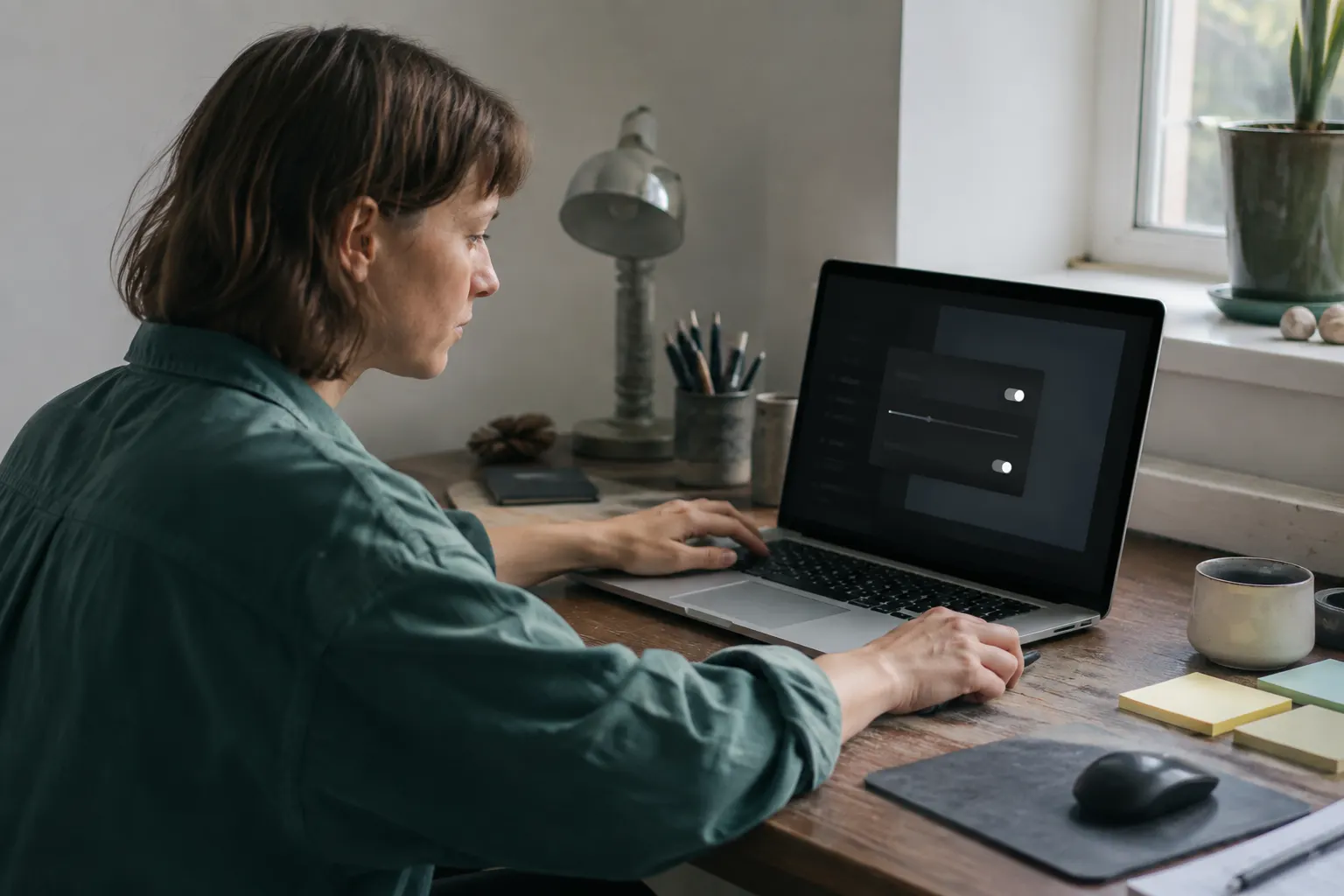
- Turn on your operating system's reduce-motion setting. A compliant site detects it through the prefers-reduced-motion media query and drops parallax and auto-animation.
- iPhone: Settings > Accessibility > Motion > Reduce Motion. Windows: Settings > Accessibility > Visual effects > Animation effects off. macOS: System Settings > Accessibility > Display > Reduce motion.
- Not every site honors the setting, so also scroll slowly and use reader mode where it is available.
- All paths here were checked as of August 2026.
Frequently asked questions
Why do parallax websites make me dizzy?
Parallax pages scroll the background and foreground at different speeds and often auto-animate their hero sections, so layers drift independently as you move. Your eyes read that depth-faking motion while your body is still, and for a sensitive viewer that is enough to bring on dizziness. It is the same conflict as any moving screen, from a scrolling page rather than a video.
How do I stop parallax scrolling from making me sick?
Turn on your device's reduce-motion setting. Well-built sites check for it through the prefers-reduced-motion media query and switch parallax and auto-animation off. On iPhone it is Settings > Accessibility > Motion > Reduce Motion, on Windows it is under Accessibility > Visual effects, and on macOS it is Accessibility > Display > Reduce motion. Not every site respects it, so scroll slowly and use reader mode where you can.
How do I know whether a site is honoring my reduce-motion setting?
Turn the setting on, reload the page, and watch the top of it without scrolling. If a background is still drifting or an element still slides in by itself, the site is ignoring it. You can also scroll a short way and stop: on a site that respects the setting, the layers move with your scroll rather than at different speeds from each other.
Can my browser block parallax?
Not with a switch of its own. Browsers read the reduce-motion preference from your operating system and pass it to the page, so the control lives in system accessibility settings rather than in the browser. Chrome, Safari, Firefox and Edge have all supported that signal for years, which means the gap is sites that never wrote the code to respond to it. Reader mode strips the layout on article pages and is the closest thing to a manual override.
Is it the parallax or the scroll hijacking that gets me?
They are separate problems and it helps to know which one you have. Parallax drifts layers at different speeds. Scroll hijacking takes over your scroll so the page moves at a pace you did not choose. Losing control of the pace is the harder one for most sensitive readers, and reduce motion often does not fix it, because the site counts that scrolling as essential.
Leave the moving page for a break
Close the laptop before opening another app. If you want to try Dizzout during the break, prepare ordinary headphones while seated away from the display.
Free to download. Paid subscription for full access. Or go straight to the App Store or Google Play.
 Scan to open on your phone
On a computer? Dizzout installs on your phone. Scan the code, or open dizzout.com/get on your phone and it'll take you straight to the right store.
Know someone who gets motion sick?
Send them the app that helps stop it, drug-free, in about 90 seconds, works with any headphones. Free to try.
More screen triggers
Related
- What cybersickness isThe screen version of motion sickness, and the three symptom groups it comes in.
- Does your phone have a motion sickness setting?Which makers built one in, and what the built-in features cannot do.
- VR motion sickness (headset version)Why headsets trigger it, the comfort settings that help most, and how to build tolerance.
- Video game motion sickness, by gameThe 20 games players report most, each with the settings that help.
Sources & further reading
Your next question, probably
Does your phone have the setting?
iPhone, Samsung and Pixel, and what each one cannot do
If that is not your question:
Settings paths were checked at the makers' own support pages and at MDN as of August 2026, where a first-party source exists; the rest is labelled reported and dated. Device menus change with software updates and vary by model, so your own settings menu is the final word. Apple, Samsung, Sony, LG, TCL, Roku, Vizio, Amazon, TikTok, Instagram, Google and DJI are trademarks of their respective owners; Dizzout is not affiliated with or endorsed by them. Sensitivity varies from person to person; this page is informational and not medical advice.