
Motion Sickness in the Subaru Outback: Why It Happens & How to Prevent It
The Subaru Outback is the most-named gas car in the online motion-sickness conversation, where some owners describe a soft, "floating" ride feel while others praise its tall seating and clear sightlines. It is a genuinely contested model, so here is both sides and what actually helps.
Wagon / Crossover · ICE · Reader-reported motion-sickness risk: mixed, very person-dependent.
- Low
- Moderate
- High
- Very high
Risk levels summarise what passengers and riders commonly report, not measured testing.
Key facts
- The Subaru Outback is a wagon / crossover. It runs a combustion engine.
- Reader reports place it in the moderate band for motion sickness.
- 6 design factors are documented on this page as motion triggers in the Subaru Outback.
- Best seat: For a motion-sensitive rider, the front passenger seat with eyes on the horizon is best, and the Outback's tall stance and big windows make that forward view easy.
- Settings that matter: Not an EV or hybrid, so there is no regen or one-pedal setting to adjust.
Try Dizzout free. Put it on your phone before you go, so it is there when you need it. Drug-free, any headphones.Free · works with any headphones · no account to try
Stop car sickness. Free to try, no card needed. Or go straight to the App Store or Google Play.
Why the Subaru Outback can trigger motion sickness
Owners commonly report that the Outback, especially from the 2018 redesign onward, can produce a soft "floating, more like a boat than a car" sensation tied to its comfort-tuned suspension and its CVT, whose nearly imperceptible ratio changes remove the acceleration cues passengers normally feel. That slow, low-frequency body float sits near the vibration band that ergonomics research (Kato & Kitazaki) identifies as the most nauseogenic. At the same time, the Outback is frequently cited as a good choice for its high seating position and excellent outward visibility, which give the eyes a clear view of the moving horizon, so the same car that bothers one rider feels composed and easy for another.
- The CVT's smooth, continuous ratio changes remove the acceleration cues passengers instinctively use to anticipate motion, a feel some sensitive riders find disorienting
- Comfort-tuned suspension can give a soft, low-frequency 'float' over road undulations that owners describe as boat-like, most often discussed on 2018-and-newer models
- Owners report the tall-sidewall OEM tire setup contributes to the floaty feel; some say switching to a lower-profile tire sharpened the ride
- Rear-seat passengers tend to feel the float more than the driver, who anticipates every input
- On the positive side, the high seating position and large windows give strong outward visibility, which helps the eyes track the horizon
- Common owner mitigations include a stiffer (e.g. STI) rear sway bar and turning off lane-keep steering assist, both reported to reduce the float
Best seat & setup in the Subaru Outback
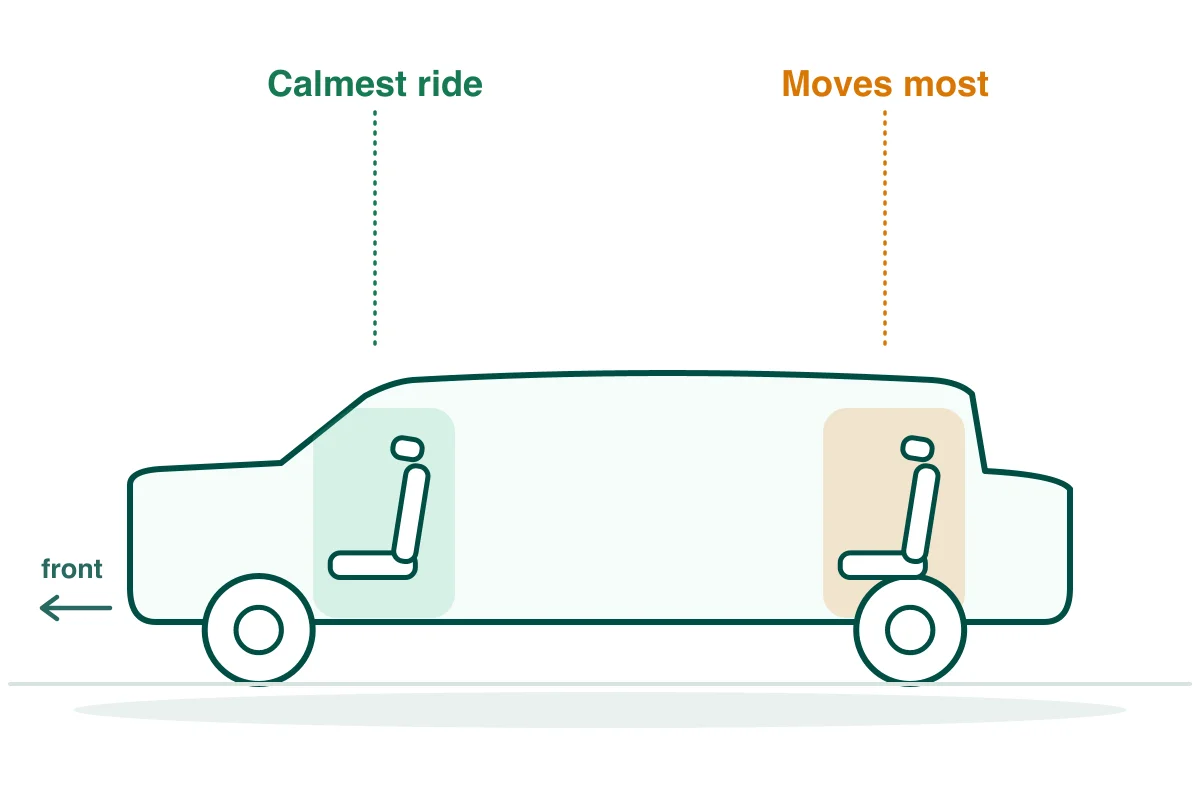
For a motion-sensitive rider, the front passenger seat with eyes on the horizon is best, and the Outback's tall stance and big windows make that forward view easy. Some owners report that a stiffer rear sway bar or a lower-profile tire noticeably reduces the floaty feel for back-seat riders.
Not an EV or hybrid, so there is no regen or one-pedal setting to adjust. Owners do commonly report that switching off the lane-keep steering assist removes small steering corrections that can add to the floaty sensation.
Going on a drive in the Subaru Outback? Set it up first
Set it up before you pull out, not at the first lay-by. Dizzout is a drug-free app that plays precisely calibrated audio through any headphones you already own, wired or Bluetooth, with relief in about 90 seconds. Free to try.
Before you need it: find out how prone you are
Take the free 2-minute testTwo minutes, no sign-up, and it ends with a drug-free plan to prepare.
Put it on your phone before you go
Free to try, no card needed. Or go straight to the App Store or Google Play.
 Scan to open on your phone
On a computer? Dizzout installs on your phone. Scan the code, or open dizzout.com/get on your phone and it'll take you straight to the right store.
Know someone who gets motion sick?
Send them the app that helps stop it, drug-free, in about 90 seconds, works with any headphones. Free to try.
What helps in the Subaru Outback
- Sit up front with eyes fixed on the road and the distant horizon, which the Outback's good sightlines make easy, rather than reading or looking down at a phone
- Keep the cabin cool and ventilated, with a window cracked or fresh-air vents aimed at your face
- Avoid screens, books, and looking down at devices while moving, since that widens the eye-versus-inner-ear mismatch
- For back-seat sensitivity, owner-reported tweaks like a stiffer rear sway bar or a lower-profile tire are often said to reduce the low-frequency float
- Take short breaks on longer drives and step out for fresh air when you start to feel off
- Dizzout is a drug-free, screen-free sound therapy you can start the moment symptoms begin; most users feel better in about 90 seconds. Over-the-counter options also exist, but follow the label or ask a pharmacist.
The screens-away item on that list has a page of its own, with the trials attached: see the verdict on putting your phone away.
Frequently asked questions
Why does my Subaru Outback feel like it's floating?
Owners commonly attribute the floating sensation to the Outback's comfort-tuned suspension paired with its CVT, which together produce a soft, low-frequency body motion with few acceleration cues. It is most often discussed on 2018-and-newer models, and some owners report that a stiffer rear sway bar or lower-profile tires reduces it.
Is the Outback a good or bad car for motion sickness?
It is genuinely mixed. Some owners report the floaty CVT ride bothers sensitive passengers, while others praise the tall seating and clear outward visibility that make it easy to watch the horizon. Whether it works for you depends on your sensitivity and seat position.
Does the CVT cause the motion sickness?
The CVT is part of what owners describe. Because it changes ratios smoothly and almost imperceptibly, passengers lose the acceleration cues they would feel in a geared transmission, which some sensitive riders find disorienting. It is one design characteristic among several, not a defect.
Other car motion-sickness guides
Sources & further reading
Your next question, probably
Car sick on every single drive?
The graded plan that builds tolerance ride by ride
If that is not your question:
Based on publicly reported owner experiences and the vehicle's documented design characteristics, as of 2026. Vehicle and brand names are trademarks of their respective owners; Dizzout is not affiliated with or endorsed by them. Motion-sickness sensitivity varies by person, so this is informational, not a vehicle review or a substitute for a doctor's advice.