
Motion Sickness in the Jeep Wrangler: Why It Happens & How to Prevent It
The Jeep Wrangler is built to crawl over rocks, not to glide down the interstate, and that trade-off shows up in how the ride feels. Owners commonly report that passengers, especially in the back seat, can feel queasy on longer paved drives, even though the same hardware is exactly what makes the Wrangler so capable off-road.
Off-road SUV · ICE · Reader-reported motion-sickness risk: a common complaint among motion-sensitive riders.
- Low
- Moderate
- High
- Very high
Risk levels summarise what passengers and riders commonly report, not measured testing.
Key facts
- The Jeep Wrangler is a off-road SUV. It runs a combustion engine.
- Reader reports place it in the high band for motion sickness.
- 6 design factors are documented on this page as motion triggers in the Jeep Wrangler.
- Best seat: For a motion-sensitive rider, the front passenger seat is best: it sits roughly between the axles and has the clearest forward view, so keep eyes on the horizon.
Try Dizzout free. Put it on your phone before you go, so it is there when you need it. Drug-free, any headphones.Free · works with any headphones · no account to try
Stop car sickness. Free to try, no card needed. Or go straight to the App Store or Google Play.
Why the Jeep Wrangler can trigger motion sickness
The Wrangler is one of the vehicles most often named on "worst for motion sickness" buyer lists, and Jeep owner forums echo it: threads like "Back Seat Passenger Motion Sickness?" and "Side to side rocking motion on the Wrangler Unlimited" trace the feeling to the truck's solid front and rear axles, short wheelbase, and tall, boxy body. These are design characteristics of a serious off-roader, not defects, and owners widely praise the same setup for its articulation, ground clearance, and go-anywhere capability. The point for a motion-sensitive rider is simply that a body-on-frame, solid-axle SUV transmits road texture and side-to-side rock more directly than a car-like crossover does.
- Solid front and rear live axles (the foundation of the Wrangler's off-road ability) transmit road inputs and bumps to the cabin more directly than independent suspension
- A short wheelbase, especially on two-door models, lets the body pitch fore-and-aft over undulations and expansion joints
- Owners describe a side-to-side rocking or 'wandering' motion on the highway that is partly inherent to solid-axle steering
- The tall, slab-sided body produces noticeable body lean in corners and catches crosswinds
- The rear seat sits much closer to the rear axle, while the front seats sit roughly midway between the axles, so back-seat riders feel the most bounce
- Tall ride height and a high beltline can limit a back-seat rider's clear forward view of the road
Best seat & setup in the Jeep Wrangler
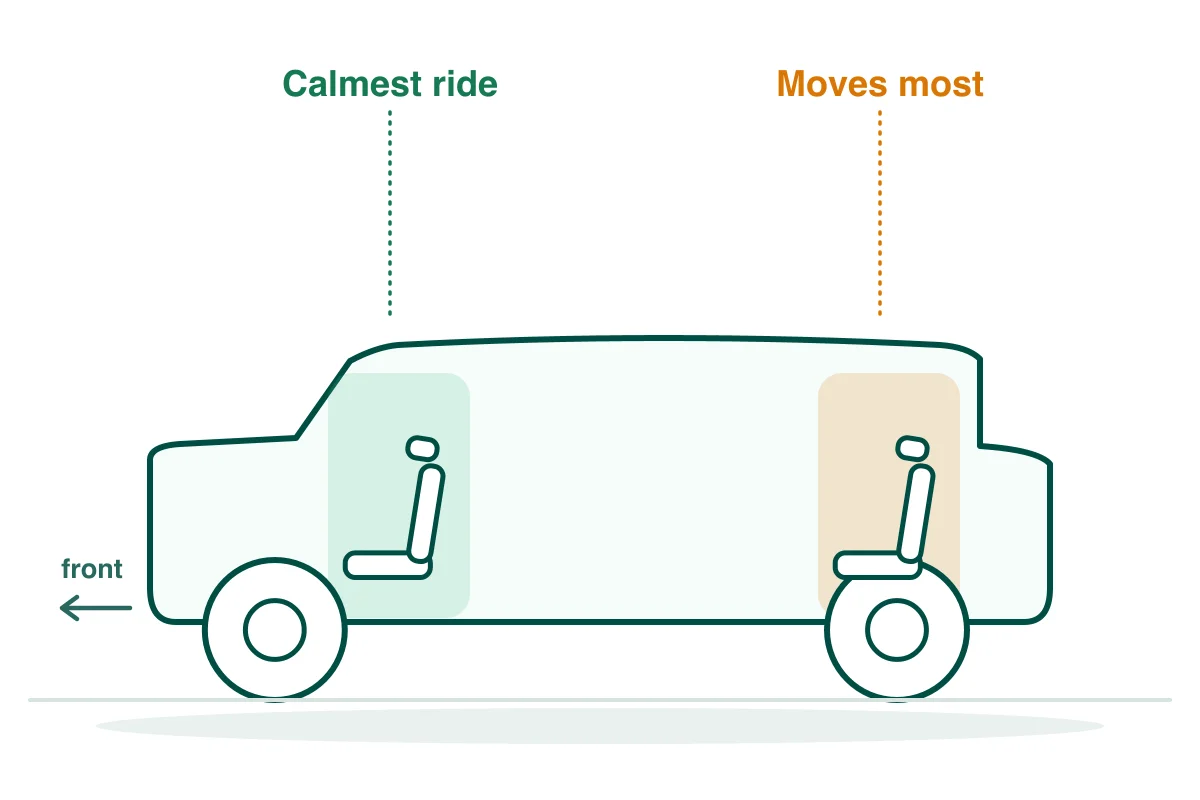
For a motion-sensitive rider, the front passenger seat is best: it sits roughly between the axles and has the clearest forward view, so keep eyes on the horizon. Back-seat riders feel the bounce and rock the most, so on longer paved trips keep the cabin cool and well ventilated, break the drive into shorter legs, and avoid looking down at phones or books.
Going on a drive in the Jeep Wrangler? Set it up first
Set it up before you pull out, not at the first lay-by. Dizzout is a drug-free app that plays precisely calibrated audio through any headphones you already own, wired or Bluetooth, with relief in about 90 seconds. Free to try.
Before you need it: find out how prone you are
Take the free 2-minute testTwo minutes, no sign-up, and it ends with a drug-free plan to prepare.
Put it on your phone before you go
Free to try, no card needed. Or go straight to the App Store or Google Play.
 Scan to open on your phone
On a computer? Dizzout installs on your phone. Scan the code, or open dizzout.com/get on your phone and it'll take you straight to the right store.
Know someone who gets motion sick?
Send them the app that helps stop it, drug-free, in about 90 seconds, works with any headphones. Free to try.
What helps in the Jeep Wrangler
- Seat the most motion-sensitive person in the front passenger seat, eyes up and on the road ahead and the horizon, not on a phone or book
- Keep the cabin cool and move fresh air through the vents (or briefly open a window or the top) to head off that early warm, clammy feeling
- Take highway legs at a steady pace and keep trips shorter for sensitive back-seat riders, since the bounce and side-to-side rock build over time
- Some owners report that upgraded shocks (for example, a quality monotube set) and properly maintained steering components reduce the side-to-side rocking and wander
- Try Dizzout, a drug-free, screen-free sound therapy you can start the moment symptoms begin; most users feel better in about 90 seconds
- Over-the-counter motion-sickness options exist if you want them: follow the label and ask a pharmacist or your doctor, and a pediatrician for children
The screens-away item on that list has a page of its own, with the trials attached: see the verdict on putting your phone away.
Frequently asked questions
Why does the back seat of a Jeep Wrangler feel worse for motion sickness?
The rear seat sits close to the rear axle, while the front seats are roughly midway between the axles. Combined with the Wrangler's solid axles and short wheelbase, that means back-seat riders feel more of the bounce and side-to-side rock, and they also tend to have a less clear forward view, which owners commonly report as a trigger.
Is the Wrangler's bouncy, rocking ride a defect?
No. The solid front and rear axles, short wheelbase, and tall body that make the ride feel busy on pavement are the same features that give the Wrangler its off-road articulation and clearance. It is a design trade-off many owners happily accept, not a flaw, though it does make the ride character more noticeable for motion-sensitive passengers.
Will a Wrangler 4xe feel different for motion sickness?
The 4xe is a plug-in hybrid, so it adds regenerative braking, which some owners find produces an unfamiliar deceleration feel; the underlying solid-axle, short-wheelbase ride character is the same as the gas Wrangler. Smooth, gradual braking and the seating and ventilation tips above apply to both.
Other car motion-sickness guides
Sources & further reading
- https://www.jlwranglerforums.com/forum/threads/back-seat-passenger-motion-sickess.117569/
- https://www.wranglerforum.com/threads/side-to-side-rocking-motion-on-the-wrangler-unlimited.1944730/
- https://www.yourmechanic.com/article/the-best-used-cars-to-buy-if-you-get-motion-sickness
- https://wwwnc.cdc.gov/travel/page/motion-sickness
Your next question, probably
Car sick on every single drive?
The graded plan that builds tolerance ride by ride
If that is not your question:
Based on publicly reported owner experiences and the vehicle's documented design characteristics, as of 2026. Vehicle and brand names are trademarks of their respective owners; Dizzout is not affiliated with or endorsed by them. Motion-sickness sensitivity varies by person, so this is informational, not a vehicle review or a substitute for a doctor's advice.