
Motion Sickness in the Tesla Model 3: Why It Happens & How to Prevent It
If the Tesla Model 3 feels planted and quick from the driver's seat but leaves a passenger queasy, you are not imagining it. The Model 3 sits at the center of the "Tesla nausea" conversation, where the trigger owners most often name is the car's strong one-pedal regenerative braking rather than the chassis itself.
Sedan · EV · Reader-reported motion-sickness risk: a common complaint among motion-sensitive riders.
- Low
- Moderate
- High
- Very high
Risk levels summarise what passengers and riders commonly report, not measured testing.
Key facts
- The Tesla Model 3 is a sedan. It is fully electric.
- Reader reports place it in the high band for motion sickness.
- 6 design factors are documented on this page as motion triggers in the Tesla Model 3.
- Best seat: For a motion-sensitive rider, the front passenger seat with eyes forward on the horizon is the most settled spot.
- Settings that matter: The Model 3's deceleration "feel" is the most-reported trigger, so soften it: if your car offers a Low regen setting, select it; otherwise learn to feather the accelerator so lift-off is gradual rather than abrupt.
Try Dizzout free. Put it on your phone before you go, so it is there when you need it. Drug-free, any headphones.Free · works with any headphones · no account to try
Stop car sickness. Free to try, no card needed. Or go straight to the App Store or Google Play.
Why the Tesla Model 3 can trigger motion sickness
The Model 3 anchors the "Tesla nausea" threads on owner forums, where drivers and their passengers commonly tie the discomfort to the strong regenerative pullback when the driver lifts off the accelerator, plus the silent cabin that strips out the engine cues people normally use to brace for a stop. At the same time, the Model 3 is regularly praised for its low center of gravity and composed, planted handling, so the same car that feels confident to the person steering can still unsettle a back-seat rider looking down at the center screen. Owners also frequently raise that Tesla removed the adjustable "Low" regen toggle on the Model 3 and Model Y around mid-2020, though a software update later reportedly brought a Low option back for some configurations.
- Strong one-pedal regen creates a sustained lift-off deceleration that passengers cannot easily anticipate; the adjustable 'Low' setting was removed on the 3/Y around mid-2020, though a later software update is reported to have restored a Low option for some cars
- The near-silent cabin removes the engine pitch and revs that, in a gas car, help the brain predict braking and pre-tense the neck
- Instant electric torque can make acceleration feel abrupt unless Chill mode is engaged
- The center-screen layout (no instrument cluster ahead of the driver) encourages passengers to glance down rather than at the road, widening the eyes-versus-inner-ear conflict
- In Hold stopping mode the car can pitch fore-aft as it settles at a full stop, which some riders find unsettling
- Rear-seat passengers commonly report feeling it more than the driver, who controls and therefore predicts every input
Best seat & setup in the Tesla Model 3
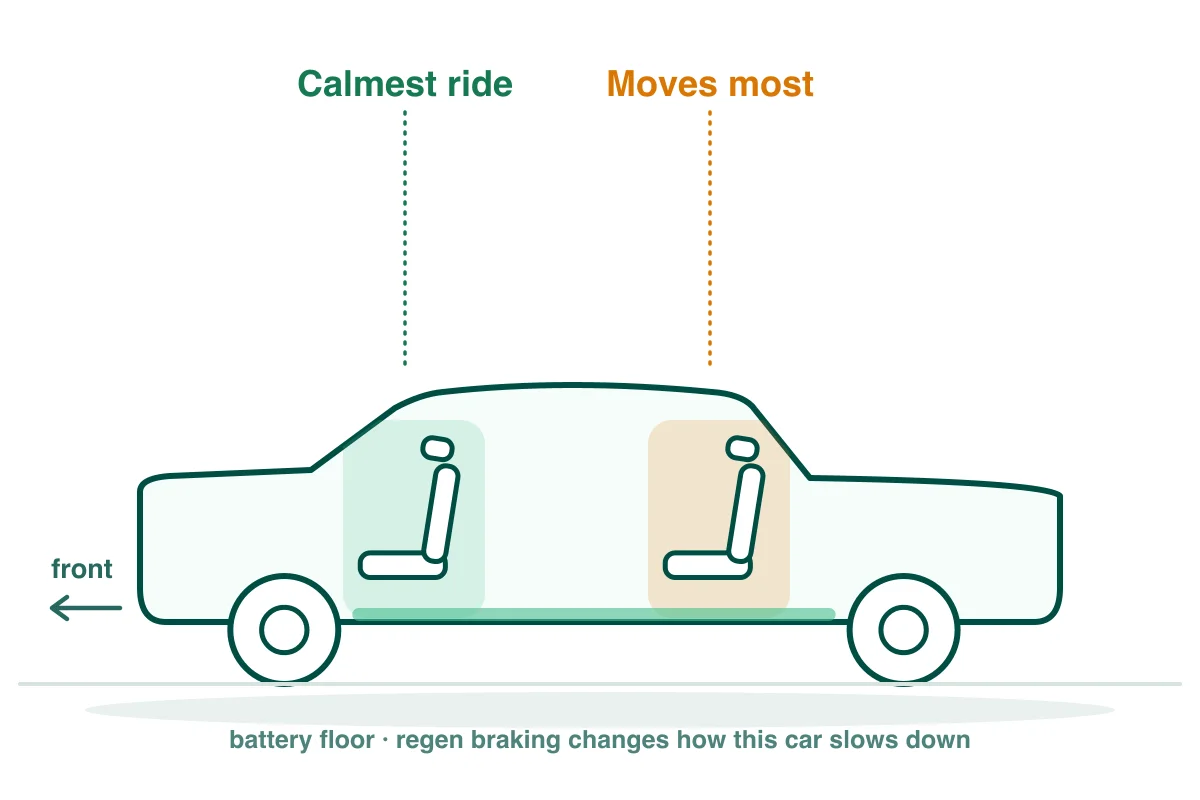
For a motion-sensitive rider, the front passenger seat with eyes forward on the horizon is the most settled spot. Switching the stopping mode from Hold to Creep or Roll so the car doesn't pitch hard at stops, and selecting Chill acceleration, both soften the inputs. Avoid reading or watching the center screen while moving.
The Model 3's deceleration "feel" is the most-reported trigger, so soften it: if your car offers a Low regen setting, select it; otherwise learn to feather the accelerator so lift-off is gradual rather than abrupt. Switch the stopping mode from Hold to Creep or Roll so the car eases to a stop instead of pitching, and use Chill acceleration to take the edge off instant torque. These are owner-adjustable levers, and on-road research on regen intensity found that lighter deceleration brought on symptoms later and less severely for motion-sensitive riders.
Going on a drive in the Tesla Model 3? Set it up first
Set it up before you pull out, not at the first lay-by. Dizzout is a drug-free app that plays precisely calibrated audio through any headphones you already own, wired or Bluetooth, with relief in about 90 seconds. Free to try.
Before you need it: find out how prone you are
Take the free 2-minute testTwo minutes, no sign-up, and it ends with a drug-free plan to prepare.
Put it on your phone before you go
Free to try, no card needed. Or go straight to the App Store or Google Play.
 Scan to open on your phone
On a computer? Dizzout installs on your phone. Scan the code, or open dizzout.com/get on your phone and it'll take you straight to the right store.
Know someone who gets motion sick?
Send them the app that helps stop it, drug-free, in about 90 seconds, works with any headphones. Free to try.
What helps in the Tesla Model 3
- Sit up front with your eyes on the horizon, where the road ahead confirms the motion your inner ear feels
- Soften the deceleration: choose a Low regen setting if available, or feather the accelerator, and switch from Hold to Creep/Roll so stops are gradual
- Use Chill acceleration mode so the instant torque feels smoother
- Keep your eyes off the center screen and put phones and books away while the car is moving
- Crack a window or aim a vent at your face and keep the cabin cool
- Dizzout is a drug-free, screen-free sound therapy you can start the moment symptoms begin; most users feel better in about 90 seconds. Over-the-counter options also exist, so follow the label or ask a pharmacist
The screens-away item on that list has a page of its own, with the trials attached: see the verdict on putting your phone away.
Frequently asked questions
Why do I get carsick in a Tesla Model 3 but not in my old gas car?
Owners most often point to two things working together: the strong one-pedal regenerative braking, which creates a deceleration your body doesn't expect when the driver lifts off the accelerator, and the quiet cabin, which removes the engine sounds you used to rely on to predict braking. Sitting up front, easing the regen feel, and keeping your eyes on the road usually help.
Can I make the Model 3's regen braking gentler?
Tesla removed the adjustable 'Low' regen toggle on the Model 3 around mid-2020, though a software update is reported to have brought a Low option back for some cars, so check your menu. If yours doesn't offer Low, the practical workaround owners use is feathering the accelerator so lift-off deceleration is gradual, switching the stopping mode from Hold to Creep or Roll, and selecting Chill acceleration.
Is the Model 3 a bad car if you get motion sick?
Not necessarily. Its low center of gravity and composed handling earn it praise, and the discomfort owners describe tracks the deceleration feel and seat choice rather than a chassis flaw. Many motion-sensitive riders are comfortable once they sit up front, soften the regen and acceleration, and keep their eyes on the horizon instead of the screen.
Other car motion-sickness guides
Sources & further reading
- https://insideevs.com/news/768941/tesla-nausea/
- https://teslamotorsclub.com/tmc/threads/motion-sickness.229555/
- https://bobistheoilguy.com/forums/threads/motion-sickness-and-tesla-model-3.381165/
- https://insideevs.com/news/451393/tesla-removes-regenerative-braking-adjustment/
- https://doi.org/10.1080/10447318.2025.2499155
Your next question, probably
Car sick on every single drive?
The graded plan that builds tolerance ride by ride
If that is not your question:
Based on publicly reported owner experiences and the vehicle's documented design characteristics, as of 2026. Vehicle and brand names are trademarks of their respective owners; Dizzout is not affiliated with or endorsed by them. Motion-sickness sensitivity varies by person, so this is informational, not a vehicle review or a substitute for a doctor's advice.