
Best Motion Sickness Wristband: Sea-Band vs Reliefband and More
Which band is best? The everyday answer is Sea-Band: the low-cost, drug-free acupressure band to try first. Reliefband, an FDA-cleared electrical-pulse device, is the higher-priced option many people reach for when a simple pressure band does nothing. Psi Bands and Blisslets are the same acupressure idea in a nicer-looking package. Wristbands don't work for everyone, so if yours hasn't helped, Dizzout is a drug-free app that plays precisely calibrated audio through any headphones, nothing to wear, and is free to download.
Key facts
- Motion sickness wristbands come in two different kinds: acupressure bands that press on the P6 point, and electrical devices that stimulate the median nerve.
- Sea-Band, Psi Bands and Blisslets are all acupressure bands, the same mechanism in different designs.
- Reliefband is the electrical kind, is FDA-cleared, is sold over the counter, and needs charging.
- Sea-Band sells a children's version, marketed for ages 3 and up.
- The clinical evidence for acupressure against motion sickness specifically is mixed, so results vary a lot between people.
"Motion sickness wristband" covers two very different products that get lumped together. One is a cheap elastic band with a plastic bead that presses on a point inside your wrist (acupressure). The other is a battery-powered device that sends mild electrical pulses to a nerve in your wrist (neuromodulation). They cost wildly different amounts, and people's results with both are all over the map.
This roundup is honest about that. Acupressure bands like Sea-Band, Psi Bands and Blisslets are inexpensive, reusable and safe for kids, but the evidence for motion sickness specifically is mixed: some travelers swear by them, others feel nothing. Reliefband works through a different mechanism and is FDA-cleared, but it's a sizeable purchase and still doesn't help everyone. If you've already tried a band and it didn't move the needle, we've included Dizzout at the end as a drug-free, nothing-to-wear alternative you can download for free.
There is a drug-free option in this comparison too. Dizzout works through precisely calibrated sound on any headphones, free to download on iOS and Android.
Get your personalized Dizzout plan. Paid subscription for full access.

On your phone? Scan to start there.
Motion sickness wristbands compared, with Dizzout (drug-free app) as a nothing-to-wear alternative
| Feature | Sea-Band (acupressure) | Reliefband (electrical) | Psi Bands / Blisslets | Dizzout (app) |
|---|---|---|---|---|
| How it works | Pressure on P6 wrist point | Electrical pulses to median nerve | Pressure on P6 wrist point | Calibrated sound via headphones |
| Drug-free | Yes | Yes | Yes | Yes |
| Causes drowsiness | No | No | No | No |
| Works after symptoms start | Mixed / varies | Mixed / varies | Mixed / varies | Designed to work after symptoms start |
| Time to notice anything | Varies by person | Varies by person | Varies by person | Dizzout states relief in about 90 seconds |
| Needs prescription | No | No (FDA-cleared, OTC) | No | No |
| Needs to be worn / charged | Worn on wrist | Worn + charged or batteries | Worn on wrist | Nothing to wear; uses your headphones |
| Typical price | A few dollars per pair | Higher-priced device | Mid-priced (style upgrade) | Free to download; $7.99/mo or $49.99/yr for full access |
| Where it works | Wrist only | Wrist only | Wrist only | iOS + Android, used in 30+ countries |
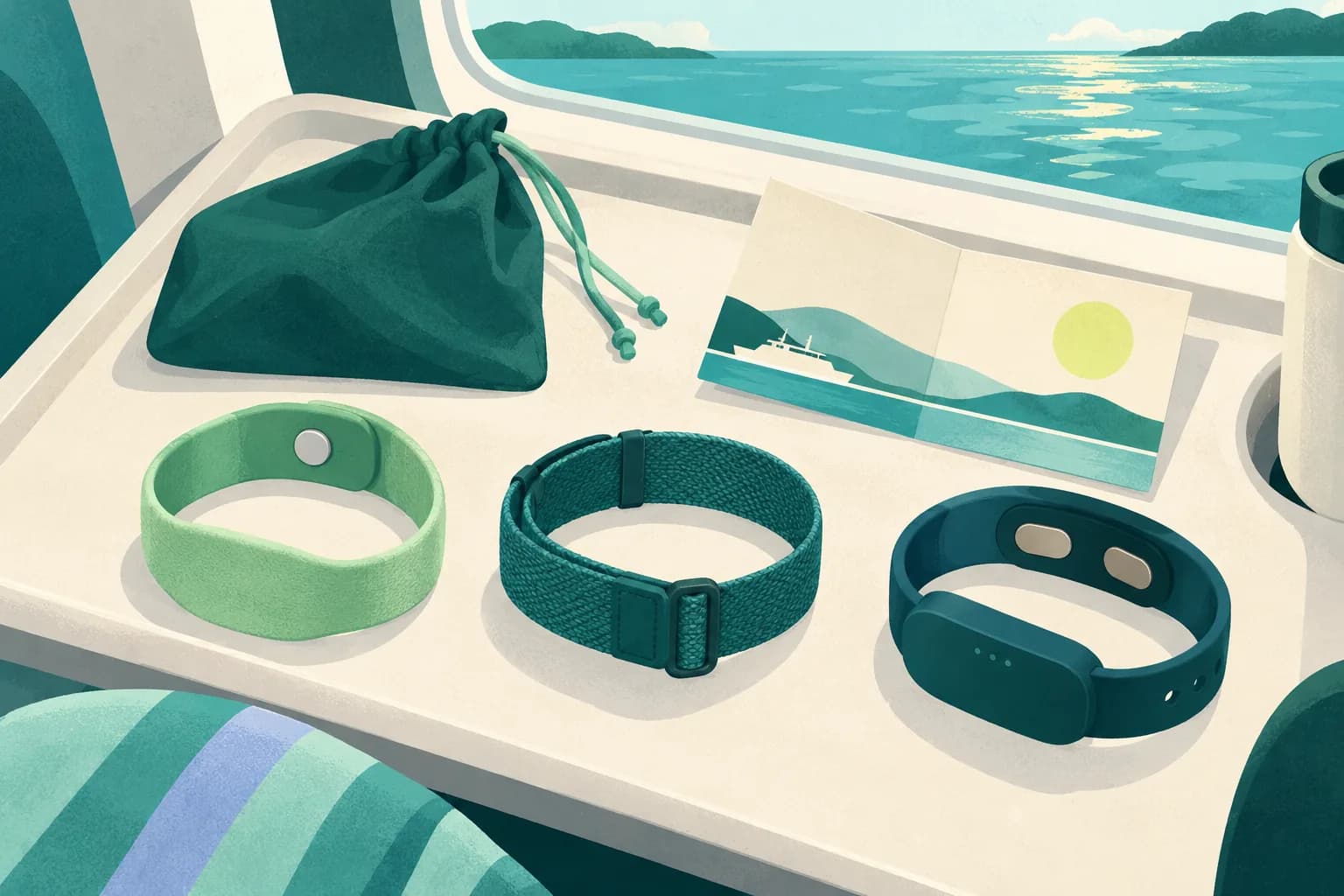
Acupressure bands: Sea-Band, Psi Bands, Blisslets
These are all the same idea executed differently. Each has a stud or bead that sits over the P6 (Nei-Kuan) point on the inner wrist, two to three finger-widths up from the crease, and the band holds it there with steady pressure. Sea-Band is the original and cheapest, usually a few dollars a pair, reusable, and the brand most pharmacies stock. Psi Bands and Blisslets are essentially the same mechanism in a slimmer, more jewelry-like design for people who don't want the medical look.
The honest read: they're drug-free, have no side effects worth noting, are safe for children (Sea-Band markets a kids' version for ages 3 and up), and cost almost nothing to try. The catch is that the clinical evidence for acupressure against motion sickness specifically is mixed: results vary a lot from person to person. They're a sensible, low-risk first thing to try; just know they don't work for everyone.
Reliefband: the electrical wristband
Reliefband is a different category. It's a wrist-worn device that sends gentle electrical pulses to the median nerve on the underside of the wrist; those signals travel through the nervous system toward the part of the brain involved in nausea. It's FDA-cleared and is also marketed for morning sickness and chemotherapy-related nausea, which is part of why people take it more seriously than a pressure band.
The trade-offs are cost and fuss. It's far more expensive than an acupressure band, needs charging or a battery, and has an intensity dial you adjust. Some users find the pulsing sensation odd at first. It still doesn't work for everyone. Many people land on Reliefband precisely because a cheap pressure band did nothing for them. For a deeper look, see our Reliefband alternative breakdown.
EmeTerm 2 is another powered wristband. Like Reliefband, it stimulates the median nerve electrically rather than pressing on the wrist, and both EmeTerm 2 and Reliefband 2.0 have US FDA 510(k) records whose stated uses include nausea and vomiting from motion sickness. A 510(k) shows substantial equivalence to a device already on the market, not that one band works better than the other, and we found no trial that compares EmeTerm with Reliefband directly. Our EmeTerm vs Reliefband comparison goes through both records.
Reliefband models, side by side
Reliefband sells five models on reliefband.com: Classic, Flex, Sport, Premier and Premier+. All five use the same electrical-pulse idea at the wrist. They differ in battery, water rating, intensity levels and controls. Here is what each product page states, read on October 3, 2026.
Classic: 5 level settings, replaceable batteries (two come installed), rated for 150 hours of use, splash-resistant casing.
Flex: 5 level settings, replaceable batteries (two come installed), rated for over 350 hours of use, listed as water resistant. A smartwatch band, sold separately, lets you wear it together with an Apple or Samsung watch.
Sport: 6 level settings, rechargeable, rated for 30 hours on one charge, IPX7 waterproof. It takes the same smartwatch band as Flex.
Premier: 10 level settings, rechargeable, rated for 18 hours on one full charge.
Premier+: 10 level settings, rechargeable, rated for 26 hours on one full charge, with a digital display that shows a clock, and spray and splash resistance.
Which one fits depends on how you travel. If you swim or sail, look at the water rating first. If you travel often, decide whether you would rather charge it or carry spare batteries. More levels or a display does not mean a model works better for motion sickness, and none of them helps everyone.
Sources: the reliefband.com product page for each model, read on October 3, 2026.
Where wristbands fall short
Both kinds of band share the same honest limitation: they help some people and do little for others, and there's no reliable way to know which group you're in until you try. You also have to be wearing the band, positioned correctly, ideally before symptoms ramp up. Fishing a band out of a bag once you're already green and clammy is not where they shine. Electrical devices add charging, cost and a learning curve on top of that.
None of this makes wristbands a bad choice. They're drug-free and low-risk, which is exactly why they're worth trying first. But if you've genuinely given one a fair shot and it didn't help, the answer isn't always a fancier band. Sometimes it's a different approach.
Dizzout: the drug-free, nothing-to-wear alternative
Dizzout takes the wrist out of the equation. It's a drug-free motion-sickness app that works through calibrated sound on any wired or Bluetooth headphones you already own: no band, no charging, no special hardware. It's on iOS and Android, is used in 30+ countries, and is one of the very few sound-therapy motion-sickness apps on the iOS App Store.
Two things travelers tend to like versus a band: it's designed to work both before you travel and after symptoms have already started, and there's no drowsiness because it isn't a drug. Dizzout states relief in about 90 seconds. It's free to download, and full access is a paid subscription at $7.99/month or $49.99/year. If a wristband hasn't worked for you, it's an easy thing to test on your next trip.
When to use which
If you want the cheapest, lowest-risk thing to try first, including for a child, an acupressure band like Sea-Band is a reasonable starting point. If a simple pressure band has done nothing for you, an electrical device like Reliefband is another option people weigh, though it costs more and needs charging. If you'd rather not wear anything, or you tend to reach for help only once symptoms have already started, a drug-free app like Dizzout is another option, free to download with a paid subscription for full access. None of these is a medical recommendation, and we're not ranking which works best for you. If your symptoms are severe or frequent, or you're pregnant, treating a child, or managing another condition, talk to a doctor or pharmacist about what's appropriate before relying on any device or remedy.
Try drug-free motion sickness relief
Get your personalized Dizzout plan · iOS and Android · any headphones.
Know someone who gets motion sick?
Send them the app that helps stop it, drug-free, in about 90 seconds, works with any headphones. Free to download.
Frequently asked questions
Which relief band is best?
Sea-Band is the low-cost acupressure band to try first, and Reliefband is the electrical kind people weigh when a pressure band has done nothing for them, at a higher price and with charging or batteries. Within Reliefband's own lineup there are five models: Classic, Flex, Sport, Premier and Premier+. They use the same electrical-pulse idea and differ in battery, water rating, intensity levels and controls, and the Reliefband models section on this page lists what each product page states. Sport is the one rated IPX7 waterproof. Classic and Flex take replaceable batteries, while Sport, Premier and Premier+ are rechargeable. Psi Bands and Blisslets use the same acupressure idea as Sea-Band. And if pressure on the wrist has never moved the needle for you, the honest next step is a different mechanism entirely, not a nicer band.
Do motion sickness wristbands actually work?
For some people, yes. For others, not much. Acupressure bands (Sea-Band, Psi Bands, Blisslets) are drug-free and low-risk, but the clinical evidence for motion sickness specifically is mixed and results vary a lot from person to person. Reliefband uses electrical pulses and is FDA-cleared, but it also doesn't help everyone. They're worth trying because the downside is small; just don't assume a band will fix it for everyone.
What's the difference between Sea-Band and Reliefband?
Sea-Band is a cheap elastic band with a bead that presses on the P6 point on your inner wrist (acupressure). Reliefband is a battery-powered device that sends mild electrical pulses to the median nerve (neuromodulation) and is FDA-cleared. Reliefband costs far more and needs charging or batteries; Sea-Band is a few dollars and reusable. Many people try Reliefband after a pressure band did nothing for them.
Is EmeTerm better than Reliefband?
No direct comparison answers that yet: we found no trial that tests EmeTerm against Reliefband for motion sickness. Both are wrist devices that stimulate the median nerve electrically, and both EmeTerm 2 and Reliefband 2.0 have US FDA 510(k) records whose stated uses include nausea and vomiting from motion sickness. A 510(k) shows substantial equivalence to an earlier device, not that one product works better than another. Check each model's instructions and warnings before use, especially if you have an implanted electronic device. Our EmeTerm vs Reliefband comparison covers both records in more detail.
Psi Bands vs Sea-Band: what is the difference?
Both are acupressure bands that press a stud on the P6 point of the inner wrist, so the idea is the same. Sea-Band is a knitted elastic band with a plastic stud sewn in, sold in adult, child (ages 3 and up) and XL sizes on sea-band.com. Psi Bands, according to their FDA 510(k) summary, use a rubber strap that adjusts around the wrist like a watch, plus a dial on the stud with three pressure settings. When we checked on October 3, 2026, the Psi Bands website showed "This website is no longer active". Because they rely on the same acupressure idea, what is known about acupressure applies to both, and for motion sickness that evidence is mixed.
What if no wristband helps me?
That's common, and it doesn't always mean you need a more expensive band. A different approach can help. Dizzout is a drug-free app that works through calibrated sound on any headphones, with nothing to wear and no charging, and it's designed to work both before travel and after symptoms have already started. It's free to download, with a paid subscription for full access.
Wristbands are a fair first move because they're drug-free and cheap to test: Sea-Band is the budget acupressure pick, Reliefband is the pricier electrical option, and Psi Bands or Blisslets are a nicer-looking version of the same acupressure idea. But bands don't work for everyone, and there's no reliable way to know in advance whether they'll work for you. If yours hasn't, you don't have to keep wearing something. Dizzout is drug-free, has nothing to strap on, works through headphones you already own, and is free to download.
Related comparisons
- Do acupressure wristbands work? The trial evidence
- EmeTerm vs Reliefband: what the evidence can tell us
- Do electrical wristbands work? The verdict
- Reliefband alternative: how Dizzout compares
- All motion sickness comparisons
This article is for informational purposes only and is not a substitute for professional medical advice: talk to a doctor or pharmacist, and follow each product's label. Sea-Band, Reliefband, Psi Bands and Blisslets are trademarks of their respective owners; Dizzout (Kinda Smart Inc.) is not affiliated with or endorsed by them.