
Feeling Sick on a Ship: Find Your Sea Legs Faster
That low-grade, all-day unwell feeling on a cruise or ferry, not quite vomiting but never quite right, is the most common way seasickness shows up on big ships. Modern vessels are stable enough that full-blown sickness is rarer than people fear, but the slow background roll still wears sensitive passengers down. The strategy: manage your position, your eyes, and your first 48 hours, which is when nearly everyone adapts.
Try Dizzout free. Drug-free calibrated sound through any headphones, designed to help once symptoms have started.Free · works with any headphones · no account to try
Free to try, no card needed. Or go straight to the App Store or Google Play.
Why this happens on a ship
Large ships move at a slow, rolling frequency that the human balance system finds uniquely tiring: it rarely produces sharp nausea, but it accumulates as fatigue, fogginess, appetite loss, and general malaise. Position on the vessel matters enormously: midship cabins on lower decks move several times less than forward cabins on high decks. And the body genuinely adapts: most passengers develop 'sea legs' within one to three days.
What to do right now
- 1
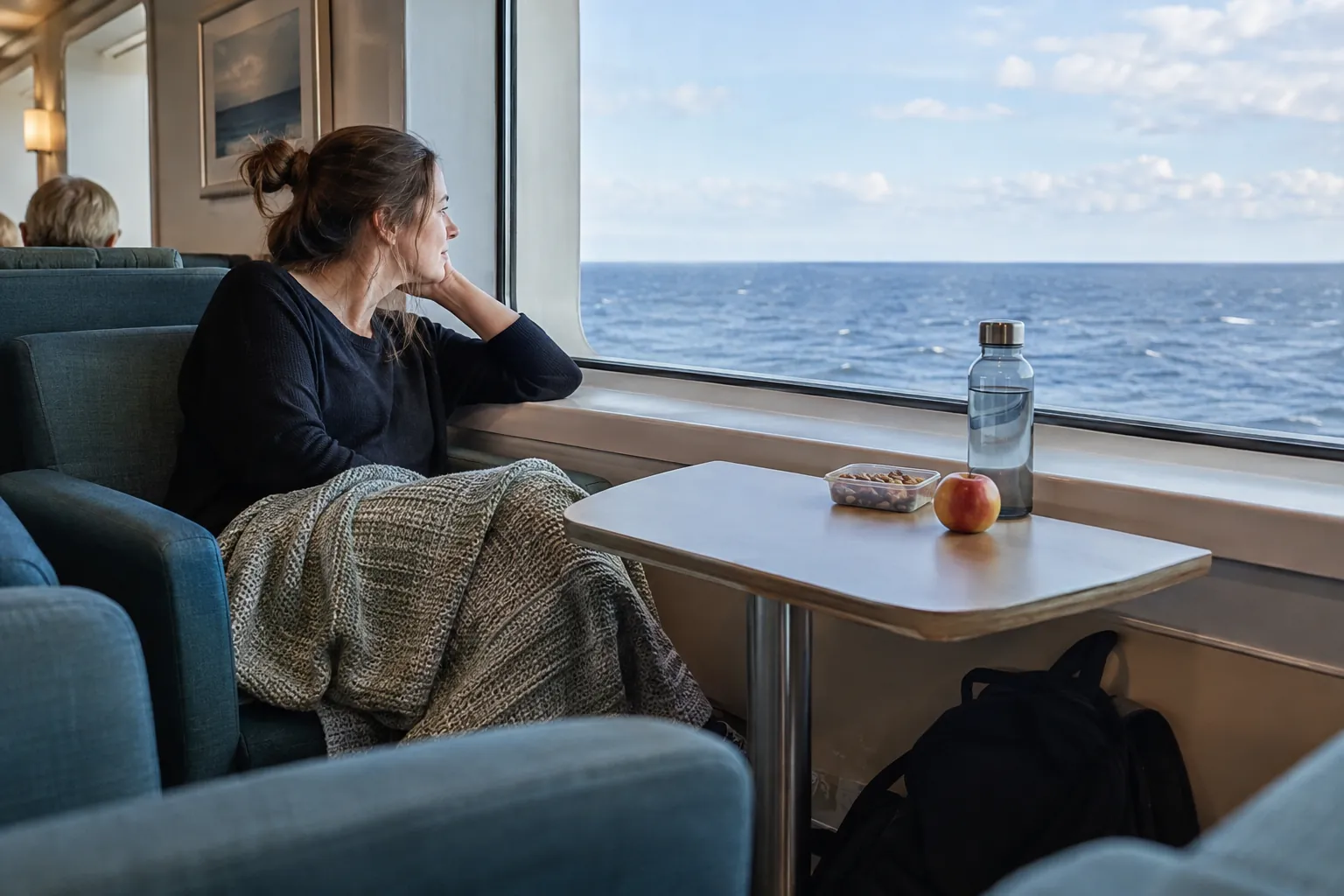
Go where you can see the horizon: an open deck or a window lounge beats an interior corridor.
- 2
Head midship and lower if you feel it building; the difference is physical, not psychological.
- 3
Eat something plain: crackers, bread, ginger tea. An empty stomach makes the malaise worse.
- 4
Run a Dizzout session through headphones; most users feel the wave ease in about 90 seconds.
- 5
Skip the alcohol until you've adapted: it reliably resets your progress.
Already feeling it?
Stop the nausea now
Open Dizzout, plug in any headphones, tap play. Drug-free, no drowsiness. Most users feel relief in about 90 seconds.
Free to try, no card needed. Or go straight to the App Store or Google Play.
 Scan to open on your phone
On a computer? Dizzout installs on your phone. Scan the code, or open dizzout.com/get on your phone and it'll take you straight to the right store.
Preventing it next time
- Book a midship cabin on a lower deck when you reserve, not after you board.
- Spend generous time on deck during your first day: visual horizon time speeds adaptation.
- Keep meals light and regular rather than skipping or feasting.
- Use Dizzout's Pre-Conditioning Mode for about 90 seconds before departure and before rough stretches.
When to see a doctor
Ship malaise that fades as you adapt is normal. If you still feel rocking and unsteady days after disembarking, that's possible mal de débarquement syndrome: mention it to a doctor. Onboard, persistent vomiting with dehydration warrants a visit to the ship's medical center rather than toughing it out.
Common questions
How long does it take to stop feeling sick on a cruise?
Most passengers adapt within one to three days as the brain learns the ship's rhythm, the classic 'sea legs.' You can speed it up with deck time, horizon viewing, regular light meals, and steady hydration, and manage the interim with drug-free sound therapy.
Why do I feel tired and foggy on a ship rather than nauseous?
Slow, rolling ship motion often triggers the sopite syndrome, a fatigue-and-fog response to sensory mismatch, instead of acute nausea. It's still motion sickness, just the drowsy variant, and it responds to the same fixes: horizon, midship positioning, and vestibular settling.
Where on a ship do you feel the least motion?
Midship, on the lowest passenger decks, closest to the vessel's pivot point. The bow, stern, and high decks all swing further with each swell. If your cabin is forward or high, spend your queasy hours in midship lounges instead.
Related guides
Medically informational; not a substitute for a doctor's advice. Persistent or unusual symptoms deserve a clinical evaluation.